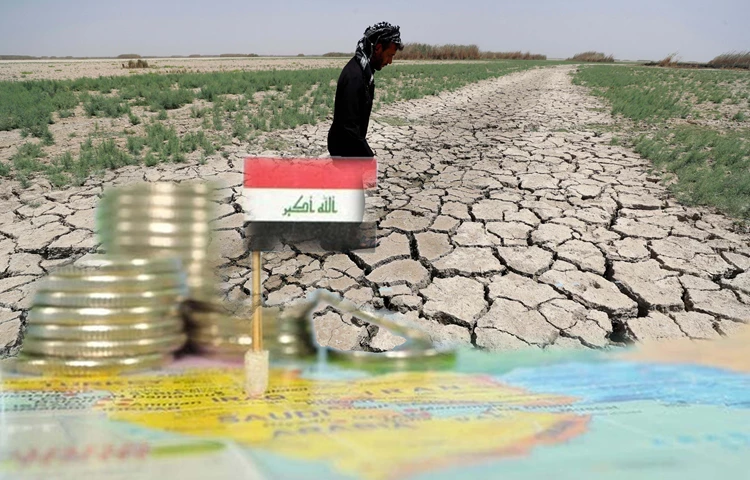
As Iraq grapples with mounting economic pressures and increasing strain on public services, experts warn that the country’s financial spending crisis and water management failures stem from a single root cause: the absence of strategic planning and a comprehensive government vision.
Economists and water specialists say inflated government spending on projects without financial sustainability, alongside the marginalization of water resources in regional agreements, has exposed a deeper governance crisis that threatens Iraq’s economic and social stability.
Economist Abbas Al-Shatri warned that the unplanned expansion of government spending has disrupted public finances and directly affected the state’s ability to meet fixed obligations, including employee salaries.
In an interview with dinaropinions.com, Al-Shatri explained that directing resources toward projects without balancing them against mandatory expenditures has pushed the government into a funding crisis, forcing it to resort to emergency measures issued by the Economic Council.
He noted that such decisions should have been taken during the early stages of the government’s term rather than at its end, describing the current approach as reactive rather than strategic.
Al-Shatri also criticized recent austerity measures, particularly sharp cuts to employee allowances, arguing that they lacked fairness. He pointed out that the three presidencies, special grades, and holders of high privileges were excluded from the cuts, a move that has intensified public discontent and raised questions about the criteria used to distribute financial burdens.
Alongside the financial turmoil, water expert Jumaa Al-Daraji highlighted serious shortcomings in the management of Iraq’s water resources, stressing that the issue was marginalized in the framework agreement between Iraq and Turkey despite its importance to national sovereignty and security.
Al-Daraji said the water file was placed at the end of the agreement’s clauses, which included more than 26 political, economic, and security axes—an indication of weak official attention to an issue increasingly shaped by regional competition and so-called “water wars.”
He added that Iraq still lacks an integrated national water management system, while neighboring countries—particularly Turkey—have successfully promoted their narratives internationally regarding water rights. This, he said, has been facilitated by Iraq’s weak negotiating position and the absence of long-term planning.
Al-Daraji further criticized official statements that reflected limited awareness of previous water agreements, saying such remarks are inconsistent with the seriousness of the current stage and the scale of challenges facing the country.
Experts agree that Iraq’s financial and water crises reflect a broader structural problem in the management of strategic state files, characterized by delayed responses and fragmented solutions rather than early planning and coherent policy.
With economic pressures intensifying and water resources continuing to decline, analysts warn that reliance on temporary fixes and the neglect of fundamental reforms could push Iraq into more complex crises. They stress the need for urgent government action to reorder priorities, adopt fair and sustainable financial policies, and safeguard the country’s long-term water security.