Called For Its Automation In Iraq.. Economist: Suspicions Of Gold Imports From The UAE
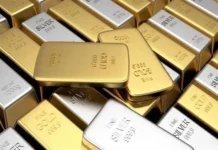
Baghdad Today – Baghdad Economic expert, Manar Al-Abidi, revealed on Friday (September 5, 2025) suspicions of gold imports from the United Arab Emirates, calling for the complete automation of the gold sector in all its stages.
Al-Obaidi said in a post on his Facebook account, followed by “Baghdad Today,” that “official data issued by the UAE Statistics Authority indicates that the volume of UAE exports to Iraq in 2024 amounted to approximately $33 billion, distributed as follows:
$12.8 billion in precious metals, mostly gold, $6.3 billion in electronic devices, the largest portion of which is mobile phones, $5.1 billion in cars, in addition to $2.3 billion in electrical and mechanical devices.”
He added, “By comparison, the UAE‘s exports to Iraq in 2023 did not exceed $23 billion, of which gold accounted for only $3.2 billion.
” He explained that “this significant increase in gold imports in 2024 raises legitimate questions, especially given that one of the main reasons for this is the use of gold as an alternative means of financial settlement in trade with some countries, in addition to its ease of liquidity in markets and its use in various financial transactions.”
Al-Obaidi asked, “Where were these massive gold imports financed?
Were they fully covered by transfers from the Central Bank of Iraq?”
He explained, “If so, this is despite the regulatory regime implemented since 2023, which limited the ability of dozens of Iraqi banks to conduct foreign transfers and focused oversight on the remaining banks. Consequently, oversight of trade finance operations should be more stringent.”
The economic expert asked, “If the gold purchase was financed outside the Iraqi banking system, what is the source of this money and why was it used to purchase and export the gold to Iraq?”
Al-Obaidi pointed out that “data for the first quarter of 2025 indeed indicates a sharp decline in UAE gold exports to Iraq by 52% compared to the same period the previous year.
However, the reasons for the significant jump in 2024 and subsequent decline in 2025 remain unclear, which calls for a serious pause.
The fact that more than 12% of Iraq’s total imports go to cover gold imports requires careful monitoring, starting with identifying the sources of financing for this commodity, moving on to its transport channels and the ports through which it entered the country, and ending with the identity of the importers and the uses of this gold.”
The economic expert emphasized the”need for economic policies to move toward fully automating the gold sector in all its layers, and to prohibit transactions except through monitored electronic payment channels, enabling tracking of sales and purchases and identifying the ultimate beneficiary of these large quantities.
The goal is not only to meet Iraq‘s actual need for gold, but also to prevent its use for purposes that could harm the national economy and undermine confidence in the Iraqi banking system.” https://baghdadtoday.news/282542-.html
Bank Deposit Growth And Cash Credit Decline In Iraq
Energy and Business 2025-09-06 Shafaq News – Baghdad The Central Bank of Iraq announced on Saturday that bank deposits in the country grew for June 2025, while credit growth registered a slight decline.
According to bank statistics reviewed by Shafaq News Agency, total deposits at banks operating in Iraq reached 117.439 billion dinars, a 1.7% increase compared to 115.360 billion dinars in May.
The bank indicated that central government deposits amounted to 37.822 billion dinars, public institutions’ deposits amounted to 25.460 billion dinars, while private sector deposits amounted to 54.157 billion dinars.
In contrast, credit growth declined slightly by 0.01% in June, reaching 71.431 billion dinars,compared to 71.504 billion dinars in May.
Credit extended to the central government amounted to 24.680 billion dinars, to public institutions 2.454 billion dinars, and to the private sector 44.349 billion dinars. https://shafaq.com/ar/اقتصـاد/نمو-الودا-ع-المصرفية-وانخفاض-الا-تمان-النقدي-في-العراق
Al-Sudani: Iraq’s Oil Reserves Amount To 150 Billion Barrels And Will Supply The World For More Than A Century.
Energy and Business breaking 2025-09-06 Shafaq News – Baghdad Prime Minister Mohammed Shia al-Sudani announced on Saturday that Iraq’s oil reserves amount to approximately 150 billion barrels, indicating that the country could supply world markets with crude oil for more than a century.
In a speech he delivered at the launch of the Baghdad International Energy Forum, attended by a Shafaq News Agency correspondent, Al-Sudani said that
Iraq has transformed, in just a few years, into an industrial and development field, with a thriving energy sector and an accelerating pace of reconstruction and development. He added that Iraq’s oil reserves amount to 150 billion barrels, ranking it among the highest in the world.
Al-Sudani also pointed out that Iraqi oil will continue to supply global markets for at least 120 years, arguing that Iraq’s export share is not commensurate with the size of its reserves, production capacity, population size, provision of services, and ageing. He expressed his hope that Iraq’s oil share would be reconsidered in line with actual capacity indicators, stressing openness to oil companies interested in investing in oil and gas.
Since the beginning of the government’s work, the energy issue, the oil wealth, and the increase in its value were present, and it was necessary to deal with the oil wealth in terms of preparing a real infrastructure for oil production. LINK
Iraq Sets A “Lifespan” For Its Oil: It Will Feed The World Until A Specific Date.
Economy 2025-09-06 | 1,204 views Alsumaria News – Economy identified Prime Minister Mohammed Shia al-Sudani on Saturday the “preferred” companies to operate in Iraq‘s oil sector, noting that Iraqi oil will supply the world for the next 120 years.
said Al-Sudani in a speech during the launch of the Baghdad International Energy Forum, followed by Sumaria News,
“We have great hopes and expectations for these forums, and in light of Iraq’s important relationship with oil producers, we must not forget that Baghdad hosted the founding of OPEC.”
Al-Sudani explained that there are “preferential measures for major oil companies in accordance with the country’s highest interests,” stressing “openness to receiving oil companies wishing to invest in oil and gas.”
He pointed out that “since the beginning of our government’s work, the energy issue has been present, particularly in the goal of expanding the use of oil wealth and raising the added value of its products, as the world is rapidly shifting towards energy diversity, especially clean energy.
” He emphasized that “we see the gas sector as a strategic economic option that enhances Iraq’s energy security and represents an opportunity to build infrastructure supporting the electricity sector.”
He pointed to the end of associated gas flaring and the full utilization of 1,300 million standard cubic feet, aswe have exceeded 70% of gas reuse, achieving a complete end to flaring within two years.
He explained that “Iraqi oil will continue to feed global markets for more than 120 years, and we are working to transform Iraqi oil into high-value products.”
https://www.alsumaria.tv/news/economy/539770/العراق-يحدد-عمرًا-افتراضيًا-لنفطه-سيغذي-العالم-لتاريخ-محدد
Planning: The Development Plan Focused On Activating Non-Oil Revenues.
Yesterday, 11:36 Baghdad – INA – Mohammed Al-Talibi The Ministry of Planning affirmed on Saturday that the five-year development plan is flexible and responsive to changes, including economic, security, and climate crises, and prioritizes service projects.
The Ministry noted that the development plan focuses on activating non-oil revenues.
“Planning takes into account all variables and sets the worst possible scenarios to at least minimize and overcome their impact,” Abdul Zahra Al-Hindawi, a spokesman for the Ministry of Planning, told the Iraqi News Agency (INA).
He explained that “the five-year development plan launched at the end of last year and extending until 2028, took into account global changes, price fluctuations, and the state of uncertainty resulting from political crises and wars, all of which have an impact on Iraq, as it is part of the global system that is affected and is affected through imports, exports, and oil.”
He added, “The ministry has moved towards activating non-oil activities, such as agriculture, industry, and tourism, in addition to developing the tax system and maximizing revenues from various sources, to reduce the impact of global and even domestic variables.”
He emphasized, “The plan was developed to be flexible, applicable, and participatory, and we have identified two main paths in it: innovation in addressing problems, and programming development action, thus achieving a balance between variables and constants.”
Al-Hindawi pointed out that “the Ministry of Planning includes projects within plans, whether regional development plans for governorates or the investment program for ministries and entities not affiliated with a ministry.
No project is implemented unless it is included within the plan by the ministry, after preparing a feasibility study.”
He pointed out that “the project that is included and begins to be implemented by the relevant entity,
the ministry’s task is to follow up on implementation and point out any errors or deviations,
and then issue letters and directives to the relevant entities regarding the reasons for the delay.”
He explained that “some projects are stalled due to problems between the implementing company and the beneficiary, and these are factors that the ministry is working to address in coordination with the relevant authorities.”
He emphasized that “the ministry is working in light of the government program and its priorities,as the program has given priority to projects of a service nature, such as sewage, water, and school projects.”
Al-Hindawi stressed that “education comes first, followed by road projects, then industrial and agricultural projects,” explaining that “priorities are also determined based on the development gap between one governorate and another.
If a governorate suffers from a problem with sewage networks, this sector is given priority, while
if another governorate suffers from a problem with drinking water, water projects are given priority.
All of this is done based on the development and spatial gap in services and projects.”
https://ina.iq/ar/economie/242688-.html
Al-Khalidi: Reforming The Port System Will Support Iraq’s Treasury.
September 5, 19:14 Information/Baghdad Former Parliament Rapporteur Mohammed Othman Al-Khalidi confirmed on Friday that reforming Iraq’s port system could contribute approximately 10% of annual revenues to the Iraqi treasury.
Al-Khalidi told Al-Maalouma News Agency: “Iraqi ports constitute strategic economic facilities, especially since they constitute a significant portion of non-oil revenues.
However, there are many question marks regarding the mechanisms of operation and the possibility of exploiting the significant opportunities available.”
He added, “Completing the multi-stage reform process of the port system,working to eliminate any suspicions of financial and administrative corruption, and automating exchanges and transactions, could transform port revenues into a significant figure that would support Iraq‘s treasury by 10% annually, thus reducing pressure on oil sales and the challenges of global price fluctuations.”
He pointed out that “Iraq will remain in a difficult economic situation if the path is not corrected and a diversified economy is not created, far from its near-total dependence on oil sales,” explaining that
“more than 90% of the treasury’s revenues come from oil sales and are used to pay wages,loans,dues to ministries and agencies,and annual salaries.” https://almaalomah.me/news/109479/economy/الخالدي:-إصلاح-منظومة-الموانئ-يدعم-خزينه-العراق
For current and reliable Iraqi news please visit: https://www.bondladyscorner.com