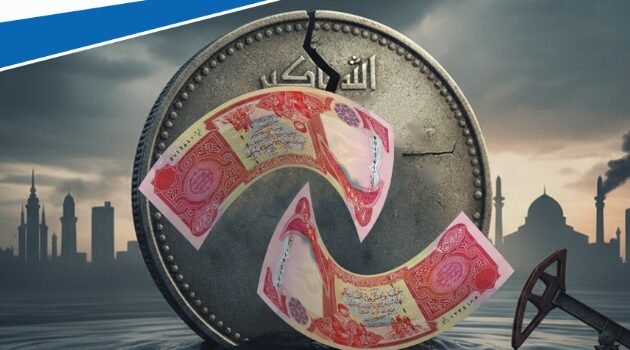
The national currency represents one of the core pillars of a country’s sovereignty. Every independent state designs its fiscal and monetary policies in line with its economic conditions and national interests. Among the most important of these is fiscal policy, through which governments seek to regulate revenues and expenditures, ensure financial stability, and support economic growth.
This process begins with the issuance of a national currency, its introduction into circulation, and the management of its volume in the domestic market. It also includes linking the currency to international benchmarks, monitoring the inflows and outflows of liquidity, and assigning the competent authorities—typically the central bank and finance ministry—to manage these flows in a way that preserves the currency’s value and supports sustainable development.
Iraq’s Monetary Balancing Act
Iraq’s situation is no exception. The government and the Central Bank of Iraq (CBI) have long sought to preserve the value of the Iraqi dinar (IQD) by maintaining a delicate balance between two main factors:
- The volume of dinars in circulation, and
- The currency’s backing in foreign reserves and precious metals.
At the same time, authorities work to control the inflows and leakages of liquidity, aiming to maintain near-equilibrium between domestic money supply and foreign exchange resources.
Such balance is critical. A distortion between the volume of currency issued and its real backing can erode confidence and lead to monetary instability. Similarly, a mismatch between liquidity inflows and outflows—for instance, between oil revenues entering the system and spending pressures on salaries, imports, and subsidies—can push the economy into a deficit position.
Emerging Signs of Strain
A careful review of Iraq’s current financial and economic indicators reveals early warning signs of strain within fiscal management. The challenge is not merely a gap between revenues and expenditures, but also a shortfall in the availability of dinar liquidity—a problem that threatens the government’s ability to meet domestic obligations, including the payment of public-sector salaries, pensions, and essential services.
This shortage of local currency, even in the presence of substantial foreign reserves, signals a structural imbalance in Iraq’s fiscal operations. It suggests that while the state maintains sufficient foreign assets (mostly from oil export revenues), it faces domestic liquidity bottlenecks—a sign that dinar supply management is struggling to keep pace with spending needs.
Why Dinar Liquidity Matters
The availability of dinar liquidity is not simply a technical issue—it directly affects the functioning of the broader economy. A persistent shortage can lead to payment delays, declining private-sector confidence, slower investment flows, and increased reliance on short-term borrowing or overdrafts by the government.
Furthermore, constrained liquidity limits the ability of banks to provide credit, undermining both consumer spending and business expansion. In such conditions, even a stable exchange rate can mask deeper structural weaknesses in fiscal and monetary coordination.
The Need for Policy Reassessment
Iraq’s fiscal framework must therefore adapt to the new realities of post-oil volatility, external shocks, and rising public spending demands. Addressing the liquidity gap requires a coordinated approach between the Ministry of Finance and the Central Bank to:
- Enhance dinar circulation efficiency,
- Reduce dependency on foreign-currency transactions for domestic operations, and
- Strengthen the link between oil revenue inflows and local expenditure channels.
Additionally, there is a pressing need to diversify revenue sources beyond hydrocarbons, improve tax collection mechanisms, and encourage banking sector modernization—all of which would ease pressure on the dinar and promote more stable liquidity conditions.
Conclusion
The current dinar liquidity challenge should be viewed as an early warning rather than an imminent collapse. It highlights the urgent need for comprehensive fiscal reform, improved public finance management, and a more proactive monetary policy capable of balancing liquidity while safeguarding stability.
Iraq’s ability to navigate this phase successfully will depend on how effectively its institutions can align monetary discipline, fiscal responsibility, and economic diversification to ensure the continued strength and sovereignty of the national currency.
Click here to read the full report [Arabic].