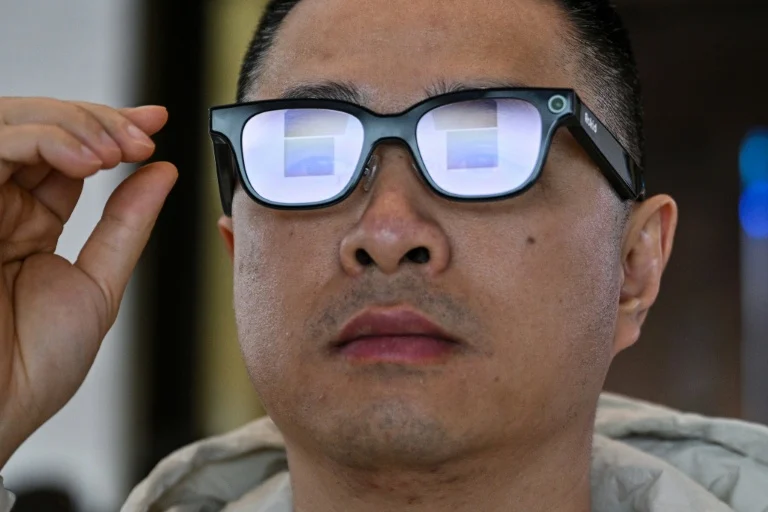
In Hangzhou, China, a new kind of AI-powered smart glasses is creating a buzz. These glasses let you pay for things just by looking at a QR code and giving a quick voice command. With AI getting better and better, more companies are jumping into the smart eyewear market, both inside China and abroad.
Right now, Meta is the global leader, but Chinese companies — big names like Alibaba and Xiaomi, and smaller players like Rokid and XREAL — are racing to catch up.
Rokid’s CEO, Misa Zhu, says China has a natural advantage: the entire tech ecosystem and supply chain are based there. He also points out that Meta’s services are blocked in China, giving local companies a huge head start in a market that’s already very comfortable with digital life. In China, people of all ages use their phones for everything — paying bills, buying groceries, booking rides — and QR code payments are everywhere.
Smart glasses are becoming a big trend. According to IDC, sales in China are expected to grow by more than 100% in 2025.
Analyst Flora Tang from Counterpoint says many Chinese brands are stepping up, including Xiaomi, RayNeo, Thunderobot and Kopin. Xiaomi, in particular, surprised everyone — its first AI glasses became the third best-selling model in the first half of 2025, even though they were only on the market for about a week.
Rokid is also gaining attention. It recently raised over $4 million on Kickstarter. CEO Zhu says the company is watching and learning from global tech giants, but also doing things differently. For example, Rokid glasses let users in China access Chinese apps, while users abroad can access other app ecosystems — something Meta doesn’t offer.
The glasses also support multiple AI models. Rokid openly uses OpenAI and can connect to Llama, Gemini, and Grok. Another cool feature they showed off in Hangzhou was real-time translation. As someone spoke in Chinese, bright green English subtitles appeared inside the lenses.
Still, competing with Meta outside China won’t be easy. Meta held 73% of the global smart glasses market in early 2025, thanks mainly to the popular Ray-Ban Meta Smart Glasses, which look stylish and completely normal.
Chinese companies, meanwhile, are working hard on design, weight, and comfort. Many customers say appearance matters most — people want glasses they actually want to wear. Rokid recently announced partnerships with Bolon, a brand owned by Ray-Ban’s parent company, EssilorLuxottica.
Experts say Chinese companies are quick to adapt and release new models, but foreign brands still lead in advanced tech like full-color displays and optical waveguides. Rokid’s VP Gary Cai admits there’s still a gap in chip technology, but the differences in AI models are shrinking fast.
Even as interest grows, smart glasses still face big challenges. The user experience isn’t perfect yet, and privacy concerns remain a serious issue — especially with devices that could record quietly at any time.
Still, companies are optimistic. Zhu believes that today’s phones are accessories for smart glasses — and in the near future, it might be the other way around.