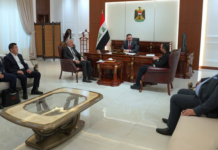
The Ministry of Labor announces the release of the social assistance payment for March.
Money and Business Economy News – Baghdad The Ministry of Labor and Social Affairs announced today, Thursday, the release of the social assistance payment for March 2026, which included nearly two million (2,070,000) families in Baghdad and the governorates, excluding the Kurdistan Region, with a total amount exceeding 444 billion dinars.
The head of the Social Protection Authority, Ahmed Al-Mousawi, explained in a statement received by “Al-Eqtisad News” that the number of families supported by men amounted to more than 1,499,000 families, with a total amount exceeding 358 billion dinars, while the number of families supported by women amounted to more than 570,000 families, with an amount exceeding 85 billion dinars.
Al-Mousawi called on the beneficiary families to visit the disbursement outlets to receive the aid allocated to them, stressing the keenness of the Authority and the Ministry to deliver support to those who deserve it, and to strengthen the social protection system for vulnerable groups. https://www.economy-news.net/content.php?id=66393
Dollar Prices Rise Again In Baghdad Markets
Money and Business Economy News – Baghdad The exchange rate of the US dollar against the Iraqi dinar rose this morning, Thursday, in the markets of the capital, Baghdad.
The dollar exchange rate in Baghdad’s main Al-Kifah and Al-Harithiya exchanges was recorded at 156,000 dinars per 100 dollars, compared to 155,600 dinars per 100 dollars on Wednesday.
Selling prices also rose in exchange shops in the local markets of Baghdad, where the selling price reached 156,500 dinars for 100 dollars, while the buying price recorded 155,500 dinars for 100 dollars.https://www.economy-news.net/content.php?id=66396
The Central Bank Of Iraq Reveals A Decrease In Foreign Currency Reserves.
Banks Economy News – Baghdad The Central Bank of Iraq revealed on Thursday that its foreign currency reserves will decrease by the end of 2025.
The bank said in an official statistic that its foreign currency reserves at the end of last year amounted to $97.433 billion, or the equivalent of 126.661 trillion dinars, down from 2024 when they amounted to $100.367 billion, or the equivalent of 130.347 trillion dinars.
He pointed out that the reserves for 2024 also decreased compared to 2023, reaching $111.736 billion, or the equivalent of 145.257 trillion dinars.
He indicated that the value of gold within these reserves amounted to 31.488 trillion dinars, while foreign investments amounted to 93.266 trillion, while the cash holdings in the Central Bank’s vaults amounted to 1 trillion and 907 billion dinars. https://www.economy-news.net/content.php?id=66401
Equating Risks In Oil And Financial Markets And The Geopolitical Tensions In The Middle East
Economy News – Baghdad Dr. Haitham Hamid Mutlaq Al-Mansour / Economist
Amid the rapidly escalating events on the regional and international stages, particularly the Iranian-American-Israeli conflict, its direct and indirect effects on global economic variables, especially energy and financial markets, are increasing. Recent data shows a significant rise in oil prices following the military strikes and heightened tensions, with Brent crude reaching nearly $70 per barrel, its highest level since mid-2015.
This upward trend is expected to continue if the conflict is prolonged or if supplies through the Strait of Hormuz, one of the world’s most vital energy chokepoints, are affected. Approximately 20% of global oil exports pass through this strait.
Consequently, any threat to the security of this waterway will have a swift and significant impact on the stability of international markets.
Past experience suggests that escalating geopolitical tensions, even in the absence of actual supply disruptions, prompt markets to reprice risk to maintain expected returns, leading to higher prices and a shift by investors toward more conservative portfolio management strategies.
In this context, the current rise in oil prices not only reflects traditional supply and demand dynamics but also incorporates the so-called “geopolitical risk premium,” an indirect cost imposed by investors and speculators due to growing concerns about supply disruptions or the expansion of conflict.
Price movements in the current phase are more closely linked to political and military developments than to purely economic indicators, contributing to increased uncertainty in global financial markets.
This has been clearly reflected in stock and currency markets, where capital has flowed towards safe-haven assets, while shares of industrial, transportation, and energy companies have come under increasing pressure due to rising operating and production costs.
The price of gold rose from $1,950 per ounce to $1,985 per ounce, marking a 1.8% increase, while the yield on 10-year US Treasury bonds fell from 3.76% to 3.64%, reflecting increased demand for safety.
On the other hand, industrial, transportation, and energy stocks were clearly affected. The S&P 500 Energy Index fell from 650 to 635, a 2.3% decline, while shares of major airlines like Delta and United dropped by 2.7%.
This was attributed to increased operating costs resulting from the rise in crude oil prices, which jumped from $68 to $72.50 per barrel for Brent crude and from $64.50 to $67 per barrel for West Texas Intermediate.
These figures reflect the close correlation between energy and financial markets, where any supply disruption or price increase can quickly lead to significant shifts in stocks and a flight to safe-haven assets.
In the oil market, and in the medium term, if the escalation continues without an effective political settlement, oil prices are likely to move towards levels between $80 and $100 per barrel, especially if crude flows are directly disrupted by the closure of the Strait of Hormuz or attacks on oil infrastructure in the region.
In such a scenario, energy-importing economies will face rising inflationary pressures and declining growth rates, while producing countries, including Iraq, may achieve temporary financial gains in the short term, but these will be accompanied by high risks stemming from price volatility and revenue instability.
Due to recent tensions and their impact on markets, in the short term, markets typically slow down when oil prices rise because higher energy costs increase companies’ expenses and affect their profits.
In the medium term, however, if there is no actual disruption to supply, prices may remain relatively high as global demand continues, but they could gradually decline if tensions subside or major producers increase their output.
For example, Brent crude rose to around $72-73 per barrel last week amid escalating military tensions with Iran, its highest level in about seven months. There are expectations that the conflict could push prices towards $80 and even exceed $100 if supplies through the Strait of Hormuz are disrupted.
These price increases have also been priced in with a risk premium of $4-$10 per barrel in some bank forecasts, reflecting concerns about the potential security implications for the markets.
Indeed, oil markets recorded a clear rise today, March 1, 2026, as a result of the escalating geopolitical factor in the Middle East, especially after the American-Israeli strikes against Iran and its military responses, which increased the risks of disrupting supplies through the Strait of Hormuz, as follows:
Brent crude settled around $72.50 a barrel at the close of trading, up more than 2% during the session.
US West Texas Intermediate (WTI) crude closed at $67 a barrel.
After adding a geopolitical risk premium of between $8-$10 per barrel above the base level due to concerns about the impact of the conflict on supplies.
Current estimates suggest that Brent crude prices could rise to around $80 per barrel if tensions persist, and might even exceed $100 in a worst-case scenario involving a complete disruption of oil supplies through the Strait of Hormuz.
In light of these developments, OPEC+ is seriously considering a further increase in supply at its emergency meeting today, in an effort to contain price pressures and provide sufficient liquidity to global markets.
This trend comes amid escalating risks of a wider regional war threatening the world’s most important oil shipping lanes, most notably the Strait of Hormuz, a vital artery for international energy trade.
In this tense atmosphere, major energy companies and producing nations are working to calm markets as the conflict in the Middle East reaches a critical stage, particularly after recent military operations effectively closed a brief window of diplomatic opportunity that had opened in February.
The heightened security risks have also increased the likelihood of an Iranian response targeting US bases or oil facilities in the Gulf states, a threat Tehran has repeatedly issued in recent weeks. This situation places additional pressure on the OPEC+ alliance to prevent sharp price spikes that could undermine the global economic recovery and exacerbate inflation.
In this context, the primary concern for market participants is no longer the mere threat of conflict itself, but rather the potential for an actual blockade of the Strait of Hormuz or direct damage to regional processing and export facilities.
This puts OPEC+ production decisions to a real test at this stage, as they represent one of the most prominent remaining instruments of stability in a market experiencing its highest levels of uncertainty in years.
In light of these factors, the current phase represents a true test of the resilience of the global oil system and the ability of producing countries and international institutions to contain recurring geopolitical shocks.
Continued tensions will only increase the fragility of the oil market and deepen its dependence on political risks.
This necessitates that rentier states, particularly Iraq, adopt more disciplined fiscal policies, strengthen economic diversification programs, and build financial safety nets to reduce their over-reliance on oil revenues and address potential future instability. https://www.economy-news.net/content.php?id=66273