Tishwash: The coordinating framework is looking for an alternative to Maliki.
Iraqi parliamentarian: Election of a president is unlikely without prior political agreement
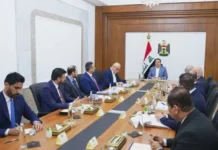
As pressure mounts to convene a parliamentary session to elect a new president, an Iraqi parliamentarian warned that the process could falter without a prior political agreement. Meanwhile, with the US vetoing Nouri al-Maliki’s candidacy remaining in place, a leader in the Hikma Movement revealed that the coordinating body is working to identify a new candidate acceptable to all parties.
Sunday, February 15, 2026 – Iraqi MP Faisal Al-Issawi told Kurdistan 24: “There is intense pressure within Parliament to hold a session dedicated to electing the President of the Republic during this week, but there is no tangible political agreement so far, and it is difficult to proceed with the session without consensus.”
Al-Issawi pointed out that the Speaker of the House of Representatives addressed the Federal Supreme Court to request clarification regarding Article (72)/ Paragraph Two/ Clause (B) of the Constitution, which relates to the continuation of the President of the Republic in his duties and setting a date for the election of his successor, stressing that everyone is waiting for the court’s response.
The data indicates that the main obstacle to electing a president lies in the failure to resolve the issue of the prime ministerial candidate within the “coordination framework.” According to the Iraqi constitution, the candidate of the largest parliamentary bloc must be tasked with forming the government immediately after the presidential election, thus linking the two positions to each other as a single package.
In this context, Sami Al-Jizani, a member of the Wisdom Movement, stated that “the coordination framework is continuing its political efforts to break the current deadlock, especially in light of the sensitive circumstances and challenges facing the region.”
Al-Jizani revealed an “anticipated political breakthrough in the next few days through the introduction of an alternative candidate,” explaining that “this candidate will be chosen by consensus of the framework’s forces, and must be acceptable and non-controversial at the local, regional, and international levels.”
Al-Jizani added that just as the Shiite forces contributed to supporting the Sunni component to decide the election of the Speaker of Parliament, efforts are now focused within the “Shiite House” to overcome internal differences.
Although Nouri al-Maliki remains the only official candidate of the Coordination Framework for the premiership at the moment, American reservations and the refusal to assign him have pushed the Framework’s forces towards searching for alternative options to ensure the government’s passage.link
***************
Tishwash: The Iraqi parliament resorts to the Federal Court to resolve the issue of the presidency… document
The Speaker of the Iraqi Parliament, Hebat al-Halbousi, has submitted a request to the Supreme Federal Court to interpret a constitutional provision related to the election of the President of the Republic, given the inability to hold a session with a quorum for this purpose.
According to an official document issued by the Presidency of the House of Representatives, published by Shafaq News Agency, the request is based on the texts of the Constitution and the Federal Court Law, and aims to interpret Article (72/Second/B), which stipulates that the President of the Republic shall continue to exercise his duties after the end of his term until a new president is elected within thirty days from the date of the first session of the House of Representatives.
The document explained that the election of the President of the Republic was not achieved within the constitutional period, despite the House of Representatives continuing to hold its sessions, due to the lack of a legal quorum in more than one session dedicated to this purpose.
The request indicated that the council continues to hold its sessions according to the usual agenda, without including the item of electing the president of the republic, due to the lack of the required quorum, and asked the Federal Court to state the legal opinion on this matter.
The Iraqi constitution stipulates that the president must be elected within a period not exceeding 30 days from the date of the first session of the House of Representatives.
Taking into account this period from the first session held on December 29, 2025, the constitutional time limit ended on the night of January 28, 2026. link
Tishwash: No turning back on the ASYCUDA… The government calls on traders to accept the new reality
The Iraqi government called on Sunday (February 15, 2026) for those objecting to the implementation of the ASYCUDA system and customs tariffs to accept the new reality and comply with the law. Speaking on behalf of the government, spokesperson Bassem Al-Awadi explained that this system, which is implemented in more than 100 countries, will be applied in Iraq under international and UN supervision. He added that part of the ASYCUDA implementation is linked to Iraq’s international obligations in the areas of combating money laundering, currency and goods smuggling, and international trade. He further stated that after 2003, Iraq relied on a process he termed “arbitrary” in managing customs and taxes, and that the time has come to change this process.
Al-Awadi stated in an interview with the official channel, which was followed by 964 Network , that “during the past few days with the beginnings of the implementation of the ASYCUDA system, there was some delay in the ports and many goods were delayed. According to the government’s estimates, some of them were delayed normally and others were delayed abnormally. When the government implemented the ASYCUDA system, this does not mean that there is a problem between it and the traders, but this step is an organizational process.”
Al-Awadi added, “In order to facilitate the movement of goods and make things easier for the private sector and Iraqi traders, the Iraqi government decided to zero out the government’s percentage of goods in warehouses – these warehouses are a joint facility between the ports and maritime transport, and also in cooperation with the private sector – so the government’s fees were zeroed out, and also 50% of the fees of the investing partner were zeroed out.”
Al-Awadi pointed out that “in light of the recent atmosphere that we all experienced, and the many rumors that try to make the government and the Iraqi state in general seem like something poised to harm the private sector or harm the people, and this is something that does not exist,” indicating that “the private sector and the merchant class are witnesses to the level of interaction that the government has undertaken, and in the end, only the truth will prevail.”
Al-Awadi pointed out that “trade from 2003 until today, especially with regard to taxes and customs, was more like arbitrariness. In simple terms, things were done in the form of a small container with 3 million and a large container with 4 million, regardless of what was inside the container. This was an old method that was imposed by the reality of the change after 2003, and it continued due to the repercussions and recent events.”
Al-Awadi stressed that “the ASYCUDA system is a United Nations system and was not brought by the Iraqi government. It is implemented in 102 countries around the world and is linked to the United Nations Convention against Torture (UNCTAD). Part of the implementation of ASYCUDA is linked to Iraq’s international obligations in the areas of combating money laundering, smuggling of currency and goods, and international trade.”
The government spokesman stressed that “this system is not targeting a specific class, and the rumors that speak of a lack of liquidity in the Iraqi state and that is why it went towards this system are untrue. All of this is incorrect, because the process of trade, accounting and customs since 2003 was an arbitrary emergency process, and in the end, now this year or next year or after 3 years, everyone knows that these temporary matters must end and we must move towards the right things.”
Al-Awadi explained that “this new system (ASYCUDA) has been implemented, and we do not have (Quranic texts nor angels). It is an electronic automation system, operated by Iraqi teams under international and UN supervision.” He pointed out that “over time and after implementation, if there is any kind of injustice that may befall an economic class, group, or a specific type of goods, there are unions and federations of the Iraqi private sector and spokespeople for them, and the door of the Prime Minister and the Iraqi government is open to them, and it is possible to address any injustice that may affect merchants or other classes.” link