An EU-backed programme focused on Iraq’s agri-food sector is starting to show real progress — and officials say it could open the door to more private investment in agriculture.
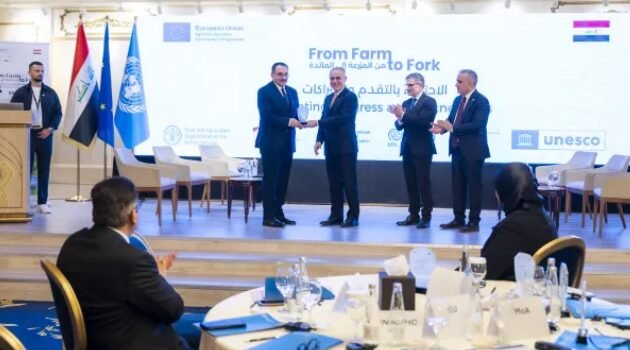
Partners involved in the Agri-food Business Development Programme (AfBDP) met in Baghdad at a high-level event organized by the Food and Agriculture Organization of the United Nations (FAO). The goal was to review what’s working, what’s improving, and how to attract more private sector money into Iraq’s farming and food industries.
Speaking at the opening, UN Resident Coordinator in Iraq, Ghulam Isaczai, stressed that cooperation is key. He said the programme shows how strong partnerships can help create jobs, improve food security, and support long-term development goals in Iraq.
The programme began in 2021 and was designed to strengthen Iraq’s agri-food system from farm to market. Instead of focusing on one part of the process, it looks at the full chain — production, processing, and sales. Seven international partners are involved, including FAO, GIZ, IOM, ILO, ITC, UNESCO, and Cowater International. Together, they work with Iraqi institutions to improve livelihoods, build stronger markets, and support key agricultural sectors.
The event brought together senior officials from the European Union, Iraq’s Ministries of Agriculture, Planning, and Water Resources, along with partner organizations and private sector representatives.
EU Ambassador to Iraq Klemens Semtner said the programme was created to help Iraqi farmers and agri-food businesses overcome real challenges — like climate pressure, water shortages, and weak links to markets. He noted that strengthening value chains has already created jobs, reduced waste, and given local producers better access to markets. More importantly, he said, it has helped make Iraq’s agri-food sector more attractive for future private investment.
During the event, partners shared results through presentations, visuals, and discussions on how to scale up investment so more farmers, processors, traders, and businesses can benefit.
One of the standout moments was a mini-market and photo exhibition, which showed real products supported by the programme. These displays highlighted better production methods, stronger links between farmers and buyers, and new opportunities for businesses to get involved.
Deputy Minister of Agriculture Mithaq Al Khafaji said the programme proves how coordinated support can drive real change in Iraq’s agriculture sector. With EU backing and partner cooperation, he said the initiative has helped connect farmers to markets and create more sustainable income opportunities.
FAO’s Representative in Iraq, Salah El Hajj Hassan, said FAO is proud to support a collective approach that brings national and international partners together. He emphasized that the programme has helped build stronger value chains and set the foundation for future investment and a more market-driven agriculture sector.
The event ended with a high-level panel discussion focused on what’s still holding back private investment, how to improve policies, and how to encourage entrepreneurship across Iraq’s agri-food industry.