Clare: Saturday is the decisive day… The Democratic Party presents its final proposals to decide the presidency.
1/30/2026
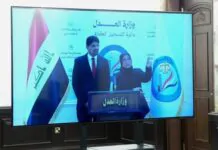
Wafaa Muhammad Karim, a leader in the Kurdistan Democratic Party, revealed today, Friday, that his party has submitted a number of proposals to the Patriotic Union of Kurdistan regarding the position of President of the Republic.
Karim explained in a statement to Al-Furat News Agency that “the proposals include granting the Patriotic Union the position of second deputy speaker of parliament and a sovereign ministry, in addition to some positions in the Kurdistan Regional Government, in exchange for giving up the position of president of the republic.”
He pointed to “another proposal that includes activating the regional parliament in one session, stressing that these proposals will mature tomorrow, Saturday, to reach a final decision.”
He stressed that “until now there is no agreement on a compromise candidate between the two sides, noting that both parties are still holding on to their respective candidates for the presidency.”
Raghid LINK
Clare: Trump’s envoy to Iraq responds to rumors of his dismissal: They are fueled by militia networks.
1/30/2026
Mark Savaya, the US president’s special envoy to Iraq, strongly denied rumors of his dismissal, according to a report published Friday by Amberin Zaman, senior correspondent for the US website “Al-Monitor”.
Zaman quoted Savaya in a post on the “X-Twitter” platform (formerly) as saying, “There is a circulation of misinformation, and it appears to be driven by Iranian-backed militia networks.”
Last October, US President Donald Trump decided to appoint Mark Savaya as special envoy to Iraq.
Mark Savaya is the third US envoy to Iraq since Paul Bremer in 2003, and after Brett McGurk, during the war against ISIS in 2014.
Savaya stirred controversy through his writings, in which he explicitly called for ending the issue of armed factions and preventing them from participating in the government, as well as issuing warnings to Iraq and cautioning against a return to a “cycle of complexity”.
It is worth noting that Savaya, an American businessman of Iraqi (Chaldean/Assyrian) origin from Michigan, has risen to prominence in recent years through his support for Trump’s election campaign and his activities within Middle Eastern communities in the United States.
He had not held previous diplomatic posts, which made his appointment surprising in political circles, but he received confirmation from Trump that he “has a deep understanding of Iraq and influential contacts in the region.” LINK
***************
Courtesy of Dinar Guru: https://www.dinarguru.com/
Militia Man The central bank is completely separate, was and always has been. Every time they have a new prime minister, they still have a central bank governor that gets nominated….An exchange rate change can happen because of that independence.
Jeff They told us two weekends ago that Savaya would be working with the US Treasury regarding OFAC. There’s no way they could tell you they’re about to lift the OFAC sanctions off of Iraq. They have to do it secretly…They’re saying, ‘Oh, we’re going to audit and review Iraq just to make sure there’s no corruption.’ No, the reason they’re auditing them is to make sure they’re complaint so they can lift the OFAC sanctions because Iraq is about to go international when they form the government. That’s what’s going on.
Jeff The way you know the rate is going to change is if you saw Iraq approving…the remaining 150 laws, which includes the ’26 budget, the oil and gas law, article 140, if you saw them working on all that you could tell yourself the rate’s not going to change because they’re getting all that done without a rate change. But the fact that they can’t do 150+ laws including the ’26 budget or the HCL…banking and tax reforms or any other reforms lets you know they’re waiting for the rate to change to implement those items…
Oliver Nailed $100 Silver – Now Calls For $300-$500
Liberty and Finance: 1-29-2026
Michael Oliver argues that silver’s recent surge is not a conventional bull market but a structural breakout, where decades of range bound pricing are giving way to a new valuation regime driven by monetary decay and relative underpricing to gold.
Using historical analogies like copper and lead, he explains how commodities can abruptly escape long held price ceilings and reprice rapidly once old constraints no longer hold, often accomplishing years of adjustment in a matter of quarters.
From a relative value standpoint, silver remains cheap versus gold despite its gains, suggesting further upside as that historical relationship normalizes alongside continued strength in gold itself.
Beneath the metals rally, Oliver identifies the more dangerous fault line in global government bond markets, where persistent high yields and central bank intervention signal a looming confidence crisis that could force aggressive money creation.
In this framework, silver, gold, and broader commodities represent real assets moving to a higher economic reality, while paper assets face rising systemic risk as the bond market strains under unsustainable debt dynamics.
INTERVIEW TIMELINE:
0:00 Intro
1:00 Silver update
17:00 Pullbacks
19:15 Commodities
22:11 Momentum Structural Analysis
https://www.youtube-nocookie.com/embed/MI7b_swoGPo?feature=oembed&enablejsapi=1