Tishwash: Ministry of Planning: The World Bank is proceeding with opening a dedicated office in Baghdad.
The Ministry of Planning confirmed that the World Bank is proceeding with opening a special office in Baghdad, in a move that reflects the bank’s support for the Iraqi government, noting that Iraq has taken excellent steps in terms of reforms, while the bank expressed its readiness to provide greater support in areas of joint cooperation.
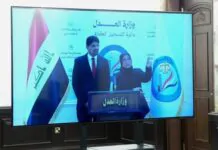
A statement from the ministry, a copy of which was received by Al-Furat News, stated that: “This came during a joint meeting with the World Bank team to discuss new projects in the current year’s budget 2026, within the framework of strengthening joint development cooperation between the two sides, in the presence of the World Bank’s Regional Director for the Middle East, Jean-Christophe Carré.”
Undersecretary for Technical Affairs Maher Hammad Johan said, “This meeting is an important step to frame the future relationship, whether at the level of the government or sectoral institutions, with the World Bank,” explaining that “the new projects were prepared in coordination with the various government institutions and ministries, especially the Ministry of Finance, in addition to the Prime Minister’s Office.”
He added, “The meeting was fruitful, during which the extent to which the Iraqi government can prepare its commitments to move forward under the umbrella of joint work with the World Bank was discussed, as well as which sectors will be targeted and the time limits for those projects.” He explained that “higher authorities will be addressed regarding what the World Bank will provide in order to benefit from it in organizing priorities before proceeding with the new budget law.”
Johan noted that “the World Bank is proceeding with opening a special office in Baghdad, which confirms the bank’s support for the government, given that Iraq has taken excellent steps, and that they are ready to provide greater support in the field of joint cooperation with Iraq.” link
**************
Tishwash: International Finance Corporation: Central Bank of Iraq measures are leading banks to finance development projects
The International Finance Corporation (IFC) confirmed on Thursday that the Central Bank’s measures are leading banks to finance development projects, while calling for the creation of a market for syndicated bank loans in Iraq.
Bilal Al-Saghir, the resident representative of the International Finance Corporation, said during his participation in the (Iraq Development Platform), which was attended by a correspondent from the Iraqi News Agency (INA): “The measures taken by the Central Bank of Iraq are leading the banking system to carry out the process of financing development projects, including energy projects of all kinds, but there are a set of limitations that frame the work of local banks operating in Iraq.”
He added that “there are two main links, the first is the financing of energy projects, which is a large-scale financing process, and therefore may conflict with the rules of credit concentration. The second link is the required financing periods, which exceed the ability of any bank to provide them, as the financing operations exceed 10 years and more, and therefore this conflicts with the scale of bank maturities.”
He added that “the banking system has a major role in financing energy projects,” calling for “the creation of a market for syndicated bank loans to combine their capabilities to provide the required financing amounts and terms.”
He continued: “The other aspect relates to activating the capital sector in Iraq,” referring to “green, regular, or blue bond operations, or green and blue sukuk, meaning the capital market.”
He explained that “international financing institutions provide ample room for partnership with local banking institutions to provide financing operations in the required sizes because they are not bound by the controls imposed on banks.”
He called for “a full partnership between the Iraqi banking sector and international financing institutions to participate in providing the required financing, which is of large volumes,” noting that “the call for participation between local institutions and the relevant international financial institutions comes to provide the required financing, as our need to implement energy projects of all kinds is an urgent need.” link
************
Tishwash: The Iraqi economy: US pressure and a liquidity crisis threaten financial stability.
Worrying indicators show the fragility of the Iraqi economy, with escalating external pressures and fluctuating oil prices, in parallel with an internal liquidity crisis that has begun to affect salaries and markets.
At a time when Iraq faces complex political and economic challenges, alarming indicators of a fragile financial situation are mounting, amidst ongoing US pressure, sharp fluctuations in oil prices, and a domestic liquidity crisis that is beginning to directly impact the lives of citizens and local markets. These factors combined are putting the Iraqi economy to a difficult test and raising serious questions about the government’s ability to contain the repercussions and maintain economic stability in the coming period.
In this context, economist Bassem Anton stressed that Iraq is subjected to multi-dimensional pressures, in which political and economic considerations are intertwined, noting that these pressures are used to achieve gains related to sensitive regional issues, most notably the Palestinian issue, the Iranian file, and the power struggles in the region.
Anton explained that the United States adopts an approach of pressure, threats, and then gradual retreat as part of managing its political interests, indicating that Iraq is still unable to draw clear paths to deal with these pressures in a way that protects its economy.
He added that a drop in oil prices to levels that could reach $45 a barrel, in the event that the markets are flooded with Venezuelan oil, will directly affect the Iraqi economy, noting that the general budget depends on oil revenues by nearly 90%, which means a possible deficit in the implementation of projects, disruption of reconstruction plans, and exacerbation of service problems.
Employee salaries
In parallel, economist Mustafa Al-Faraj warned that the continued delay in paying the salaries of employees and retirees is a dangerous indicator of a severe liquidity crisis that could lead to a gradual paralysis of local markets.
Al-Faraj explained that more than 60% of consumer activity in Iraq depends on a fixed monthly income, stressing that any delay in salaries immediately affects purchasing power and leads to a recession that begins with non-essential goods before extending to food items.
He pointed out that the repercussions of the crisis are not limited to citizens , but also put pressure on traders and small business owners, and lead to a slowdown in the cash cycle, which negatively affects tax revenues and commercial activity in general.
Al-Faraj linked the salary delay crisis to the increasing financial deficit, explaining that internal debts exceeded 80 trillion dinars, and warning of a monthly liquidity crisis if the structural imbalance in public finances is not addressed.
He stressed that the solution lies in real reforms that include reducing unnecessary expenditures, reviewing the salaries and allowances of senior officials, and controlling public spending, in order to ensure the sustainability of salaries and market stability.
Between external pressures controlling oil prices and an internal liquidity crisis threatening the regularity of salary payments, the Iraqi economy faces complex challenges that require bold decisions and urgent reforms. Continued over-reliance on oil and the postponement of financial solutions portend deeper repercussions that could affect economic and social stability, compelling the government to act swiftly to avert a recession that will be difficult to contain in the future. link