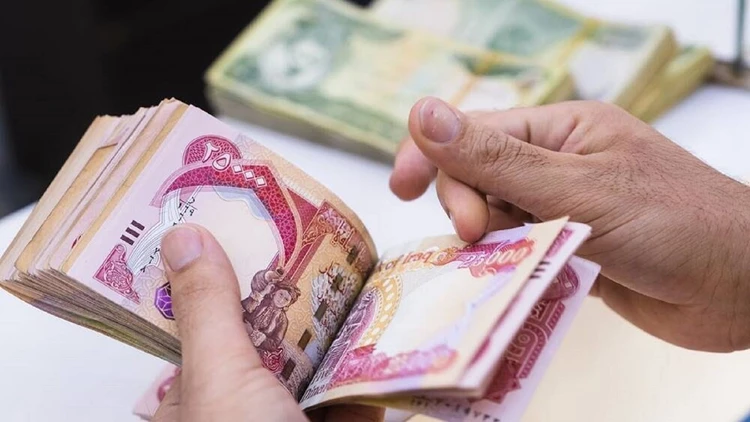
Delays in salary payments have become a growing concern among Iraqis after the government postponed disbursements by up to 10 days beyond their usual schedule, contributing to a noticeable slowdown in market activity and renewed fears of a deeper financial crisis.
The delays come amid warnings about declining liquidity, a widening fiscal deficit, and the absence of clear official explanations, raising anxiety among state employees and other groups dependent on monthly wages. The situation is unfolding while Iraq remains under a caretaker government with limited authority, heightening calls for accelerating constitutional steps to form a new government capable of addressing mounting economic challenges.
Former MP Sherwan Mirza told dinaropinions.com that while salaries are “theoretically guaranteed,” liquidity shortages are behind the obstacles faced in disbursing this month’s payments. He warned that reliance on temporary fixes such as spending cuts or delayed obligations does not constitute a sustainable solution.
“Continuing this approach could lead to greater difficulties in the coming months,” Mirza said, stressing that without structural reforms—such as combating corruption and diversifying revenues away from oil—the salary system will remain vulnerable to political and economic pressures. He added that regional tensions and the growing gap between revenues and expenditures could force the government into difficult decisions without a clear financial strategy.
In contrast, MP Firas Turki told Al-Maalomah that public sector salaries are fully secured and that no liquidity shortage exists. He attributed the delay to administrative and technical factors, explaining that the Ministry of Finance conducts a comprehensive annual audit of employee data at the start of each year, including updates to job structures. According to Turki, delays by some institutions in submitting updated data temporarily disrupted payment mechanisms.
Meanwhile, the Eco Iraq Observatory, which specializes in economic and energy affairs, reported that total state employee salaries reached approximately 56 trillion dinars by November 2025. The report stated that salaries for the Council of Ministers totaled 5.9 trillion dinars, the Council of Representatives 0.5 trillion dinars, and the Presidency 0.04 trillion dinars, bringing combined spending by the three presidencies to 6.46 trillion dinars.
The observatory described these expenditures as “astronomical” and a misuse of public funds, arguing that they come at the expense of essential public services, particularly at a time when millions of employees receive relatively low wages. It added that the continued spending pattern highlights a serious imbalance in government priorities and inequitable resource distribution.