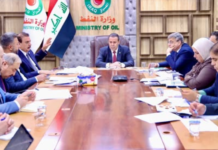
Central Bank: New Measures To Address Banks’ Inability To Deal In Dollars
Banks Economy News – Baghdad The Central Bank of Iraq announced on Sunday that it has taken several measures to address the problems of Iraqi banks that are unable to deal in dollars.
The director of the transfers department at the Central Bank, Ahmed Dawood Salman, said that “the Central Bank is continuing its procedures with international auditing companies in order to audit the previous transfer process that led to some Iraqi banks being deprived of dollars or any problems that Iraqi banks were facing that led to them being deprived of dealing in dollars.”
He added that “there are several conditions and procedures that the Central Bank has imposed on banks, as the Director General of the Investment Department for Foreign Transfers and the Director General of the Banking Supervision Department are working on this matter with the auditing firm (Olive Wyman) and we will continue and we will notice the changes in the coming days.”https://www.economy-news.net/content.php?id=67006
Greece Allocates 300 Million Euros To Address The Repercussions Of The War
Money and Business Economy News — Follow-up Greek Prime Minister Kyriakos Mitsotakis announced a €300 million support program for fuel and fertilizers, aimed at mitigating the effects of the war in the Middle East.
The Prime Minister said the Greek government would implement this program during April and May, given the continued global economic instability.
The Greek prime minister explained on Tuesday that Europe must prepare short- and long-term measures to support consumers and businesses as energy prices rise as a result of the conflict in the Middle East.
He stated that no one can predict the end of the Iran war, and expressed his hope that it would not last long, according to Reuters. https://www.economy-news.net/content.php?id=67049
Iraq Asserts Its Maritime Rights At The United Nations… A Sovereign Move That Faces Kuwaiti And Gulf Objections!
Reports Economy News – Baghdad In a remarkable diplomatic and legal development, Iraq officially deposited its maritime maps with the United Nations based on the United Nations Convention on the Law of the Sea, which opened the door to a political and legal debate with Kuwait, and broad Gulf solidarity with the Kuwaiti position.
According to an official notification issued by the United Nations (reference MZN172.2026.LOS) dated 18 February 2026, Iraq deposited on 19 January and 9 February 2026 lists of geographical coordinates accompanied by an illustrative map, pursuant to Article 16, paragraph 2, Article 75, paragraph 2, and Article 84, paragraph 2 of the Convention.
The deposit relates to determining straight baselines and baselines originating from island elevations, in addition to measuring the territorial sea, contiguous zone, exclusive economic zone and continental shelf, with the adoption of the World Geodetic System (WGS-84) as a reference for coordinates, and this procedure replaces previous deposits in 2011 and 2021.
On December 3, 2025, Iraq officially deposited its maritime boundary map with the United Nations, pursuant to Cabinet Resolution No. (266) of 2025. This resolution approved the map, which was prepared by an Iraqi technical and legal team that conducted hydrographic studies and measurements to determine the coordinates in accordance with relevant international agreements.
The map also affirms respect for the rights of neighboring countries and guarantees freedom of navigation and the smooth flow of traffic.
The Iraqi government reiterated its commitment to the relevant Security Council resolutions concerning relations with Kuwait and its intention to continue the technical and legal process for demarcating the maritime boundary beyond marker 162, as part of its efforts to resolve outstanding issues and build balanced relations with neighboring countries.
The Iraqi Ministry of Foreign Affairs stressed in a statement issued on February 22, 2026, that the decision to deposit the map of maritime zones is a sovereign matter based on nationallaws, the provisions of the United Nations Convention on the Law of the Sea, and the rules of international law.
It emphasized that the determination of maritime zones came to collect and complete previous legal procedures in one document supported by accurate coordinates, taking into account the development in international law of the sea, including the expansion of the coastal state’s jurisdiction, and noting that no state has the right to interfere in this matter, while Iraq respects the provisions and principles of international law.
In response, the Kuwaiti Ministry of Foreign Affairs asserted that the list of coordinates and map submitted by the Republic of Iraq to the United Nations, as it described it, infringes upon Kuwait’s sovereignty over its maritime zones and established and stable watersheds in relation to Iraq, such as Fasht al-Qaid and Fasht al-Aij, over which Kuwait maintains its full sovereignty has never been disputed.
The Kuwaiti Foreign Ministry summoned the Iraqi chargé d’affaires to deliver a formal protest note, urging Baghdad to consider the historical relationship between the two countries and to act responsibly in accordance with the rules of international law, the provisions of the United Nations Convention on the Law of the Sea, and bilateral understandings and agreements.
The UAE, Saudi Arabia, Qatar, and Bahrain announced their solidarity with Kuwait in the measures it is taking to protect its rights and interests, affirming their rejection of any infringement on its sovereignty or claims affecting its maritime zones, and stressing the importance of adhering to international law and the provisions of the 1982 agreement.
Saudi Arabia also affirmed its categorical rejection of any claims by any other party to rights in the submerged divided zone adjacent to the Saudi-Kuwaiti divided zone, noting the need to respect Security Council Resolution 833 concerning the demarcation of the border between the two countries.
On the domestic front, MP Mohammed Jassim Al-Khafaji asserted that the Kuwaiti map of maritime areas demonstrates the extent of the encroachment on Iraqi territorial waters, considering that this explains Kuwait’s strong objection to the new Iraqi map.
He explained that the Iraqi map was prepared by a technical and legal committee of 24 members formed under Diwani Order No. 480 of 2024, and included Iraqi experts along with two foreign experts, one German and the other Lebanese.
He indicated that the Kuwaiti map was approved under Amiri Decree No. 317 of 2014, while Iraq completed its map in 2026, after about 12 years, stressing that the file requires follow-up and a strong will to protect sovereign rights.
For his part, Jamal Al-Halbousi, an expert on borders and international waters, confirmed that the preparation of the map of Iraqi maritime areas was done according to a professional technical and legal process with the participation of Iraqi and international experts, and that the joint Iraqi-Kuwaiti committee held 13 meetings and had been aware of the map for several months.
He pointed out that the map was presented in February 2025 to the German expert, Rodger Wolfren, the former head of the Sea Court, who expressed his support for the professionalism of the work, noting that there was what he described as an overreach in the Kuwaiti map issued in 2014.
He explained that a specialized committee within the Department of Marine Sciences at the United Nations studied the map and found it, according to his statement, to be consistent with the provisions of the 1982 United Nations Convention on the Law of the Sea in terms of the measurements and materials used.
He indicated that the map defined Iraq’s maritime extent as 86 nautical miles from the baseline, comprising 12 nautical miles for the territorial sea, 12 nautical miles for the contiguous zone, and 62 nautical miles for the exclusive economic zone, noting that some fields share the contiguous and exclusive economic zones. https://www.economy-news.net/content.php?id=65982
United Airlines Is Preparing For A Scenario In Which Oil Prices Could Reach $175 A Barrel.
Energy Economy News — Follow-up United Airlines has announced its intention to reduce the number of its flights in the coming months, in a move aimed at limiting losses resulting from the sharp rise in jet fuel prices, against the backdrop of the war in the Middle East.
The company’s CEO, Scott Kirby, said the company is preparing for a scenario in which oil prices could reach $175 a barrel, while remaining above the $100 level until the end of 2027.
He noted that these levels could raise the company’s annual fuel bill by about $11 billion, exceeding its profits in its best years.
According to the company, about 5% of operating capacity will be reduced this year by cancelling less profitable flights, especially during periods of weak demand, with some international routes being suspended.
https://www.economy-news.net/content.php?id=67046