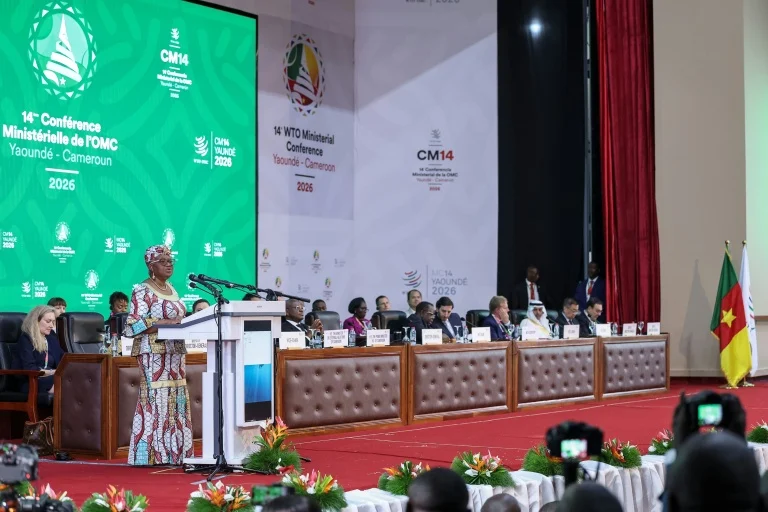
At the World Trade Organization (WTO) ministerial meeting in Yaoundé, Cameroon, tensions are building around the future role of the United States in global trade governance.
What’s happening
The second day of the conference has put the United States under heavy scrutiny from other WTO members, as many countries press Washington to clarify its position on the multilateral trading system.
According to diplomats and analysts, there is growing concern that U.S. trade policy under President Donald Trump is pushing the system toward fragmentation rather than reform.
Why countries are concerned
Many WTO members say they still want the U.S. engaged, because:
- The WTO system cannot function effectively without U.S. participation
- Washington remains central to global trade flows and rule-setting
- Reform discussions stall without American leadership
One delegate summarized it bluntly: “without them, we can’t move forward.”
Key U.S. demands
The United States is using the conference to push for major changes in WTO rules, including:
1. Revising “Most Favoured Nation” rules
This principle normally requires equal trade treatment for all members. The U.S. wants more flexibility, arguing the current system contributes to global imbalances.
2. Reclassifying developing countries
Washington argues that large economies—especially China—should not continue receiving special WTO advantages reserved for developing nations.
3. Greater subsidy transparency
The U.S. wants stricter reporting of state subsidies, amid long-standing criticism of lack of transparency.
4. National security exceptions
Washington is pushing to ensure WTO rules do not restrict national security-based trade measures, including tariffs.
A deeper institutional divide
The broader conflict is not just about trade rules, but about the structure of global trade itself.
- Some members see U.S. proposals as necessary modernization
- Others view them as a challenge to WTO consensus-based decision-making
- Countries like India oppose shifting toward smaller “plurilateral” deals inside the WTO framework
There is also frustration over the long-standing paralysis of the WTO Appellate Body, partly due to U.S. blocking of judge appointments.
The bigger concern: uncertainty
Analysts say the biggest issue is not just disagreement—but lack of clarity about U.S. intentions.
The question many delegates are asking is whether Washington wants:
- WTO reform to improve the system, or
- A weaker system with reduced enforcement power
Some fear continued uncertainty could further weaken the institution’s ability to enforce trade rules.
Bottom line
The Yaoundé meeting highlights a critical crossroads for global trade governance:
the WTO remains intact, but its future effectiveness may depend heavily on whether the United States chooses cooperation, reform, or continued pressure on the system’s foundations.