Hormuz Blockade Threatens Iraq’s Cash Buffer
2026-03-15 Shafaq News- Baghdad Iraq’s economy is under severe pressure as the closure of the Strait of Hormuz slashes oil exports, threatening the government’s ability to pay salaries, pensions, and cover essential expenses. The disruption follows the war that erupted on February 28, 2026, between the United States and Israel on one side and Iran on the other, cutting Iraqi oil production by two-thirds.
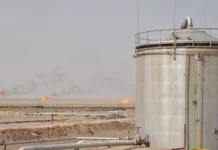
According to Eco Iraq, oil revenues make up roughly 90-95% of Iraq’s federal budget, leaving the country highly vulnerable to any drop in exports or prices. Production has fallen from 4.3 million barrels per day to 1.3 million, while exports have dropped below 800,000 barrels daily, causing daily losses of $128 million.
Revenue Pressure
Economist Ahmed Abdul Rabih linked delayed salaries directly to Iraq’s reliance on oil income. “Any disruption in oil exports or a decline in prices directly reduces the liquidity available to the government, putting pressure on its ability to cover operational costs, especially with rising public spending and an expanding workforce,” Abdul Rabih conveyed to Shafaq News.
Despite the drop in revenues, Iraq retains over $100 billion in cash reserves at the US Federal Reserve and roughly 170 tons of gold. Central bank economist Safwan Qusay reported that the Strait of Hormuz closure has cut oil income by $200-300 million per day, though reserves remain about 27% above the level needed to support the Iraqi dinar.
“These reserves could allow the Central Bank (CBI) to fund public spending of $20-30 billion over the next six months, giving the government time to manage the crisis,” Qusay added.
Public Confidence
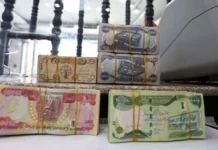
Central bank data show a 10.95% decline in bank deposits in 2025, equal to roughly 12 trillion dinars. Analysts attribute this to public caution amid economic and security uncertainty, with many citizens holding cash outside the banking system.
Rashid al-Saadi, spokesperson for the Baghdad Chamber of Commerce, pointed out Iraq’s structural economic imbalances, including heavy dependence on oil and limited investment in other sectors.
“Current financial reserves may allow the government to cover salaries for six months to a year, according to official estimates, but if the crisis continues, it raises questions about the state’s ability to maintain public spending at the same level,” al-Saadi explained to Shafaq News.
Alternative Exports
With southern ports mostly inactive, the Kirkuk-Ceyhan pipeline in Turkiye has emerged as a key alternative, though its capacity is limited compared with pre-crisis exports exceeding four million barrels per day. Al-Saadi noted that trucking or land-based transport can replace only a small portion of lost shipments.
He also recommended exploring additional regional export routes through ports such as Aqaba or Baniyas, and expanding non-oil revenue to reduce dependence on oil exports.
High Financial Commitments
Iraq requires about 9 trillion dinars ($6.8 billion) each month to cover operational expenses, including salaries, pensions, and social programs. Analysts warn that prolonged export disruptions could force the government to tap foreign reserves, potentially affecting currency stability if the situation persists.
The Ministry of Finance confirmed that salaries for March and April are secured, but ongoing disruptions could make future months more financially sensitive, emphasizing that Iraq’s ability to manage the crisis hinges on the duration of export interruptions and success in finding alternative routes or boosting non-oil income.
https://www.shafaq.com/en/Economy/Hormuz-blockade-threatens-Iraq-s-cash-buffer
Read more: Hormuz lockdown: Iraq’s economic lifeline under threat
Iraq Clinches Decade-Long Lead In Turkish Housing Market
2026-03-16 Shafaq News- Ankara Iraq has emerged as the top foreign buyer of real estate in Turkiye over the past decade, purchasing more than 51,900 homes between 2015 and 2025, the Turkish Statistical Institute (TURKSTAT) reported on Sunday.
According to the data, Iraqis narrowly surpassed Russians, who bought around 50,700 units during the same period. Iran ranked third with nearly 43,600 homes, followed by Ukraine with 38,200. Other leading foreign buyers included Saudi Arabia with 27,300 units, Kuwait with 16,800, and Germany with 15,400.
TURKSTAT also noted that Iraqi purchases started to decline after 2020, affected by economic fluctuations and changes in Turkiye’s property regulations. Despite the slowdown, Iraq maintained a strong presence, ranking second in 2020 behind Iran and third in 2022 after Russia and Iran
https://www.shafaq.com/en/Economy/Iraq-clinches-decade-long-lead-in-Turkish-housing-market
Dollar Rises In Baghdad And Erbil Markets
2026-03-16 Shafaq News- Baghdad/ Erbil The US dollar opened Monday’s trading higher in Iraq, hovering around 155,000 dinars per 100 dollars.
According to a Shafaq News market survey, the dollar traded in Baghdad’s Al-Kifah and Al-Harithiya exchanges at 155,000 dinars per 100 dollars, up from the previous session’s 154,050 dinars.
In the Iraqi capital, exchange shops sold the dollar at 155,500 dinars and bought it at 154,500 dinars, while in Erbil, selling prices stood at 154,900 dinars and buying prices at 154,800 dinars.
https://www.shafaq.com/en/Economy/Dollar-rises-in-Baghdad-and-Erbil-markets-3
Gold Prices Fall In Baghdad, Climb In Erbil
2026-03-16 Shafaq News- Baghdad/ Erbil On Monday, gold prices hovered around 1.08 million IQD per mithqal in Baghdad and Erbil markets, according to a survey by Shafaq News Agency.
Gold prices on Baghdad’s Al-Nahr Street recorded a selling price of 1,085,000 IQD per mithqal (equivalent to five grams) for 21-carat gold, including Gulf, Turkish, and European varieties, with a buying price of 1,081,000 IQD. The same gold had sold for 1,090,000 IQD on Sunday.
The selling price for 21-carat Iraqi gold stood at 1,055,000 IQD, with a buying price of 1,051,000 IQD.
In jewelry stores, the selling price per mithqal of 21-carat Gulf gold ranged between 1,085,000 and 1,095,000 IQD, while Iraqi gold sold for between 1,055,000 and 1,065,000 IQD.
https://www.shafaq.com/en/Economy/Gold-prices-fall-in-Baghdad-climb-in-Erbil-0
BP Pulls Foreign Staff From Kirkuk Oil Projects Over Security Concerns
2026-03-16 Shafaq News- Kirkuk British energy company BP has withdrawn several foreign employees from oil field development projects in Iraq’s Kirkuk province as a precaution amid rising regional security tensions, sources at the state-run North Oil Company (NOC) revealed on Monday.
The sources told Shafaq News that BP informed Iraq’s Oil Ministry and the NOC of its decision to pull out foreign personnel working within technical and advisory teams supporting the development of Kirkuk’s oil fields —including Kirkuk, Bai Hassan, Jambur, and Khabbaz, some of Iraq’s most significant and oldest producing reservoirs.
BP is cooperating with the North Oil Company on a program aimed at modernizing several oil fields in Kirkuk province, improving infrastructure for production and transport, and increasing output from reservoirs.
According to the sources, NOC currently produces around 325,000 barrels per day from fields under its management in Kirkuk and nearby areas.
Speaking with our agency, oil expert Ali Khalil explained that the withdrawal of foreign staff does not signal a suspension of the project but may slow technical tasks requiring direct supervision from international specialists, particularly advanced geological studies and reservoir development programs.
He added that international companies often adopt precautionary measures during periods of heightened security risk to protect personnel and reduce operational exposure.
The move follows heightened regional tensions after coordinated US and Israeli strikes on sites inside Iran, which prompted Tehran to launch missile and drone attacks on Israel and US military bases in the region, including Iraq, where Iran-aligned armed factions have launched attacks on American forces.
Earlier this month, more than 100 BP employees —out of roughly 650 staff working with the company— departed for Kuwait due to unstable security conditions. Experts from Chinese companies operating in oil fields in Basra province also left the area under similar circumstances.
Read more: Drone incidents reported across 14 Iraqi provinces in latest escalation
ISX Trades $10M+ In Monthly Activity
2026-03-16 Shafaq News- Baghdad The Iraq Stock Exchange (ISX) recorded more than 16.7 billion Iraqi dinars in trading value over the past month —roughly $10.8 million.
According to market data, more than 1.8 billion shares were traded during the month across 20 regular trading sessions.
The ISX60 index closed the month at 952.44 points, marking a 0.26% decline compared with the previous session.
Throughout the month, the exchange executed around 4,124 sale and purchase contracts across listed companies. During the period, 68 companies out of 104 listed firms recorded actual trading activity, while 26 companies saw no buy or sell orders matched, and 10 companies remained suspended for failing to submit the required disclosures.
https://www.shafaq.com/en/Economy/ISX-trades-10M-in-monthly-activity