Fearing They Will Be Targeted By Bombing, Kuwaiti Banks Are Closing Their Branches In High-Rise Towers.
banks Economy News — Follow-up Several Kuwaiti banks and companies announced on Sunday the temporary closure of their headquarters located in high-rise towers, following a fire that broke out on the upper floors of the Public Institution for Social Security tower as a result of it being targeted by an Iranian drone, according to what was reported by media outlets and official platforms.
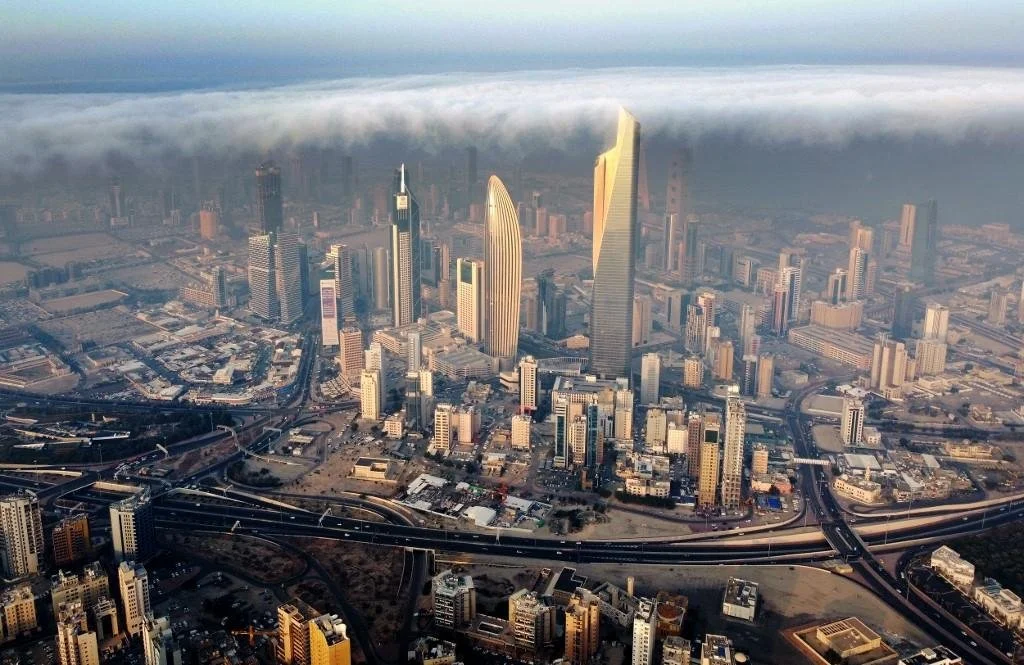
The National Bank of Kuwait said in a statement published on its X platform page that it has decided to close its headquarters starting from Sunday, March 8, until further notice, in light of current developments and in order to ensure the safety of employees and the continuity of business.
For its part, Kuwait Finance House announced the suspension of work on Sunday in the two main buildings (1 and 2) and their affiliated departments in the “KFH” tower, as a precautionary measure related to the current developments.
Boubyan Bank also announced, in a post on the “X” platform, the temporary suspension of work at its headquarters and branches for Sunday, March 8, in light of the security developments.
For its part, the telecommunications company “Ooredoo Kuwait” announced the closure of its main building branch starting today until further notice, as a precautionary measure.
These measures come at a time of escalating tension in the region, amid fears of attacks targeting high-rise or vital facilities in a number of Gulf countries. https://www.economy-news.net/content.php?id=66487
America Spends $6 Billion In The First Week Of The War Against Iran
Arabic and international Economy News – Follow-up The United States spent about $6 billion in the first week of its military operation in Iran, according to The New York Times.
According to the newspaper, the Pentagon disclosed the amount to the US Congress this week, and the newspaper indicated that $4 billion of this amount was spent on missiles, especially for Iranian missile interception systems.
The newspaper indicated that the US administration may request additional funding from Congress for the military operation, according to the Russian news agency TASS.
According to estimates published by the Turkish Anadolu Agency, US forces spent about $779 million during the first 24 hours of military operations in the Middle East, and these expenditures represent about 0.1% of the total US military budget for 2026.
The agency also estimates that the United States has lost nearly $2 billion worth of military equipment since the start of operations against Iran.
Experts warned that continuing the war could significantly increase its costs for Washington, especially with rising oil prices. A Financial Times report stated that every $10 increase in the price of Brent crude could reduce US economic growth by about 0.1 to 0.2 percentage points over 12 months. https://www.economy-news.net/content.php?id=66505
“Bullion”: Gold Will Reach These Levels If The War Lasts A Long Time.
Money and Business Economy News – Follow-up Mohamed Salah, the head of operations at “Sabaik” company, confirmed that gold will rise to $5,500 per ounce before the end of the first half of 2026, but if the war continues, it will fall to $4,800.
Salah added that the movement of gold was affected by several factors, noting that investors look for assets that generate returns during times of inflation.
Gold prices were largely stable in their last trading session globally the day before yesterday, after falling by more than 1% in the previous session, as investors continue to assess the impact of the escalating conflict in the Middle East on the global economy.
Spot gold was steady at $5,076.09 an ounce by 01:16 GMT. U.S. gold futures for April delivery rose 0.1% to $5,084.50.
The dollar was broadly steady in early Asian trading on Tuesday, on track for its biggest weekly gain in more than a year, as escalating conflict in the Middle East boosted demand for safe-haven assets.
The euro and yen remained under pressure after oil prices rose due to the conflict, fueling inflation risks in economies dependent on energy imports and upsetting expectations about the policies of the Federal Reserve (the US central bank) and other central banks. https://www.economy-news.net/content.php?id=66504
A Noticeable Decrease In Gold Prices In Local Markets
Money and Business Economy News – Baghdad Prices have fallen in local markets in the capital, Baghdad, today, Sunday, with a noticeable decline in the value of buying and selling compared to previous days.
The selling price of one mithqal of 21-karat gold from the Gulf, Turkey, and Europe in the wholesale markets of Al-Nahr Street in Baghdad was recorded at about 1.124 million dinars, while the buying price reached 1.120 million dinars, after it was higher during yesterday’s trading.
One mithqal of 21 karat local product recorded a selling price of 1.094 million dinars, compared to 1.090 million dinars for purchase.
In goldsmith shops, the selling price of a mithqal of 21-karat gold from the Gulf ranged between 1.125 million and 1.135 million dinars, while the selling price of a mithqal of local product ranged between 1.095 million and 1.105 million dinars.
In Erbil markets, 22-karat gold was priced at 1.180 million dinars, 21-karat gold at 1.128 million dinars, and 18-karat gold at approximately 967,000 dinars. https://www.economy-news.net/content.php?id=66494
Kia Tops Car Sales In Iraq For 2025
Money and Business Economy News – Baghdad Data from the Iraqi car market showed a change in positions, with South Korea’s Kia surpassing Japan’s Toyota to become the best-selling brand in the local market for 2025, while South Korea’s Hyundai dropped to fifth place.
A report by Focus 2 Move indicated that “the car market in Iraq witnessed a slight decline during 2025, with total sales decreasing by -0.7% year-on-year.”
As for brands, Kia topped the list with a growth of 19.1% and a market share of 27%, advancing one place. Toyota came in second after its sales decreased by 27.4% and it dropped one place, while the Japanese Nissan took third place after climbing ten places and achieving tremendous growth of 610.2%.
China’s MG came in fourth place with a growth rate of 7.5%, while Hyundai dropped to fifth place after losing two places.
As for models, the Kia Frontier became the best-selling car in Iraq, achieving a growth of 25.6% year-on-year, while the Toyota Hilux dropped one place to second place after losing 23% of its sales.
In the electric vehicle market, the sector saw growth of 28.8%, reaching 2% of total car sales, with the sector continuing to experience slow growth.
Toyota dominates the electric vehicle market with a 92.8% share, far ahead of Lexus and Land Rover, while Iraq’s efforts to boost non-oil revenue sources are expected to accelerate the adoption of this technology in the future.
https://www.economy-news.net/content.php?id=66498
Hormuz Tensions Threaten The Arrival Of Indian Tea To Iraq
Money and Business Economy News – Follow-up An Indian newspaper warned on Sunday that escalating tensions in the Middle East and disruptions to shipping through the Strait of Hormuz could threaten the flow of Indian tea exports to Gulf markets, particularly Iraq.
The Times of India reported that “Indian exporters are increasingly concerned about the possibility of shipment delays or disruptions to shipping in this vital sea lane, through which a large proportion of trade between Asia and the Middle East passes, which could lead to higher transportation and marine insurance costs and slower access to regional markets.”
The report, which was reviewed by Shafaq News Agency, quoted tea industry experts as saying that “about 60% of Indian tea exports pass through shipping routes linked to the Strait of Hormuz towards Middle Eastern markets, which makes the sector highly vulnerable to any geopolitical disturbances in the region.”
He added that “continued tensions may also affect food prices in importing countries, with the possibility of higher shipping costs and longer sea voyages, which may affect the supply of some agricultural and food products.”
Iraq is an important market for Asian food commodities, including tea, with trade between the two countries relying mainly on maritime transport across the Arabian Gulf.
Observers believe that any disruption to navigation through the Strait of Hormuz could slow the flow of goods to Iraq and other countries in the region, and increase pressure on supply chains in the coming period.
https://www.economy-news.net/content.php?id=66499
Iraq’s Domestic Public Debt Has Risen To More Than 8%
banks Economy News – Baghdad The Central Bank of Iraq revealed on Sunday that domestic public debt will increase by the end of 2025.
The bank said in an official statistic that “Iraq’s domestic public debt rose by the end of 2025 to reach 90 trillion and 695 billion dinars, an increase of 8.43% compared to 2024, which amounted to 83.050 trillion dinars, and an increase of 22% compared to 2023, which amounted to 70.558 trillion dinars.”
He added that “the increase came as a result of the increase in discounted treasury remittances at the Central Bank from 49.512 trillion dinars to 52.486 trillion dinars, the increase in term delivery bonds for farmers which amounted to 9.834 trillion dinars, treasury remittances in favor of government banks amounting to 1.870 trillion dinars, and the increase in loans to financial institutions to 15.608 trillion dinars.”
He pointed out that “treasury transfers at the Ministry of Finance have decreased to 1.500 trillion dinars and loans to government banks have decreased to 5.600 trillion dinars.” https://www.economy-news.net/content.php?id=66501