US Investments In Iraq: The Return Of The “Whales” Through Oil And A “Conditional” Partnership
Economy / Politics / Special Files Yesterday, 7:30 PM | 608 New test Baghdad Today – Baghdad
Since the fall of the former regime in 2003, the United States has been one of the most prominent economic players in Iraq through reconstruction and energy. Over the past two decades, the American presence has alternated between periods of openness and control over key economic levers, and periods of contraction and gradual withdrawal in favor of Asian partners, most notably China.
US investments in Iraq during this period are estimated at tens of billions of dollars, concentrated in the
oil, gas, electricity, finance, and infrastructure sectors.
However, only a third of the announced projects have actually been implemented, according to reports from the World Bank and the US State Department.
The US State Department’s 2024 Iraq Investment Climate Report notes that the country “remains a high-risk environment for foreign investment due to bureaucracy, corruption, weak enforcement of commercial laws, and a lack of transparency in public contracts.”
Exxon Mobil
ExxonMobil is the most prominent example of the fluctuating relationship between American investors and Iraq.
In 2009, the company entered the market with a major contract to develop the West Qurna 1 field, one of the largest fields in Basra.
However, it later faced a series of disputes with the Ministry of Oil over contract terms and
cost-recovery mechanisms.
After recovering its investments, it officially announced its withdrawal in 2023,
selling its 22.7% stake to the Basra Oil Company for approximately $350 million.
However, the story did not end there.
In October 2025, Bloomberg and Reuters reported that the company had returned to negotiations with the Iraqi government regarding the Majnoon field in Basra, under a more generous agreement of principles that included developing oil export infrastructure and sharing profits from external marketing. In this context,
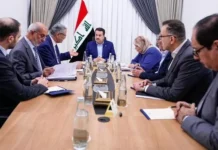
Prime Minister Mohammed Shia al-Sudani sponsored the signing ceremony of the HOA between the
Ministry of Oil and the American company ExxonMobil, in the presence of the company’s Vice President, Peter Larden, and the US Chargé d’Affaires in Baghdad. Al-Sudani affirmed that
the agreement is “an important step for the future of the oil sector in Iraq and the development of economic relations with the United States,” emphasizing “the commitment to attracting global investments and modernizing the infrastructure of the oil industry.”
Economic expert Nabil Al-Marsoumi noted in his analysis that “ExxonMobil‘s return after selling its previous stake in West Qurna for $350 million raises questions about the nature of the new contracts and their generosity,”
wondering whether this return “represents a long-term investment opening or merely a temporary deal
that reproduces the previous withdrawal scenario after profits were realized and expenses were recovered.”
General Electric
In contrast, General Electric (GE) has maintained a strong field presence in Iraq, implementing project packages
worth more than $1.2 billion between 2020 and 2023, including the supply and maintenance of generating units in Basra, Hillah, and Bazian.
Despite the technical achievement, financing and payment issues delayed some contracts, prompting the company to renegotiate sovereign guarantees with the Iraqi government to secure its dues and continue its operational commitments.
World Bank documents also indicate that international financing institutions have financed electricity projects worth $2.5 billion since 2005 with American companies participating in these projects as part of reconstruction programs and the improvement of transmission and distribution networks.
Financial Sector
Despite repeated talk of US banks’ intention to enter the Iraqi market, actual presence has been limited to a handful of representative offices such as Citigroup.
This caution is linked to the US Treasury Department‘s 2023 actions against Iraqi banks accused of poor financial compliance, making dollar transfers more complex and costly.
In contrast, the International Finance Corporation (IFC), the US-coordinated arm of the World Bank, has continued to provide direct and indirect financing exceeding $2.5 billion to support the Iraqi private sector since 2005, including projects in finance agriculture, and food production.
An Investment-Repellent Environment
Economist Nabil Al-Marsoumi, in his analyses published on his official pages and statements to the media, agrees that the investment environment in Iraq remains repulsive to foreign and local capital, due to the absence of legal and financial guarantees and the overlap of political and economic interests.
Al-Marsoumi stated, “The Iraqi environment is repulsive to investment, whether international or local,” explaining that “security conditions, administrative corruption, and the absence of fair competition deter investors from entering into long-term projects.”
In another statement, he noted that “foreign investment still faces serious challenges related to lagging infrastructure, complex bureaucratic procedures, and the proliferation of uncontrolled weapons, which makes any investment project vulnerable to political and security fluctuations.” In a separate analysis,
Al-Marsoumi noted that major oil contracts are being exploited politically inside and outside Iraq, explaining that
some projects are used as indicators of international influence rather than genuine economic projects. He emphasized that the absence of a unified economic vision has transformed Iraq into a market for political projects rather than a productive environment attractive to capital, calling for radical legislative reform and the unification of administrative authorities between the center and the provinces.
The results of the past two decades show that American investment in Iraq has not disappeared, but has changed in form and content. Whereas it was based on direct control, it now relies on conditional partnerships, selective funding, and partial projects.
In oil, Washington seeks to regain its foothold through the Majnoon field; in electricity, General Electric continues its presence despite obstacles; andin finance, American companies maintain a measured presence subject to strict scrutiny by the Treasury.
The crux of the problem, as Nabil Al-Marsoumi describes it, is that “investment in Iraq is not measured by the size of contracts, but rather by the state’s sincerity in protecting public funds and implementing transparency for all.”
https://baghdadtoday.news/284812-.html
Economist: Iraq Has The Capacity To Export Petroleum Products By 2026.
October 7, 11:19 AMInformation/Baghdad… Economic expert Ali Al-Furaiji confirmed on Tuesday that
Iraq has the necessary capabilities to export petroleum products, particularly gasoline and kerosene, during the coming year, provided that it achieves self-sufficiency in these products during the current year.
Al-Furaiji told Al-Maalouma News Agency, “Current data indicates that the Basra and Kirkuk projects are entering stable service, which will enable Iraq to achieve self-sufficiency in gasoline in the near future.”
He added, “Iraq has been able to achieve self-sufficiency in kerosene and diesel fuel since 2024, with a real possibility of achieving an export surplus in 2026, provided that the new units continue to operate stably, especially the catalytic cracking (FCC) unit, and that the hydrogen and energy supplies needed for the hydrogenation units
are guaranteed.”
He pointed out that “achieving this goal requires effective management of distribution and blending operations to ensure that products comply with international specifications, in addition to strengthening financial and pricing governance to prevent a return to unjustified imports,” indicating that
“success in the new refining plans requires strict technical and financial management that transforms self-sufficiency into a starting point for an export surplus after 2026.” End 25N
https://almaalomah.me/news/112242/economy/اقتصادي:-العراق-يمتلك-القدرة-على-تصدير-المشتقات-النفطية-في-2
For current and reliable Iraqi news please visit: https://www.bondladyscorner.com