Sudanese Advisor: The Iraqi Economy Has Maintained Its Stability Despite The Challenges
Money and Business Economy News – Baghdad The financial advisor to the Prime Minister, Mazhar Muhammad Salih, confirmed on Wednesday that the Iraqi economy has maintained its stability despite the challenges.
Saleh said, according to the official newspaper, that “the announced figures for the Consumer Price Index, which is the official indicator of annual inflation compared to 2024, show a high stability in the standard of living and the value of monetary income for the Iraqi individual.
Saleh added that the inflation growth rate did not exceed a very low level, noting that the figure came below the normal fraction of acceptable annual price growth, which usually ranges between 2 and 3 percent, which gives a positive indication of the ability of the Iraqi economy to maintain price stability despite the various economic challenges.
He pointed out that “the annual inflation rate for 2025 was very slightly positive, with an average growth rate of approximately 32.0 percent, meaning that prices rose very limitedly compared to 2024, even though most of the 7 months of the year out of 12 witnessed a decrease in inflation rates.
He explained that the indications of the price index from an economic theory perspective, low inflation is a positive indicator in controlling the money supply, and that there is stability in the exchange rate, and the absence of external price shocks.
These indicators promise success for monetary and trade policies, as well as success for the policy of supporting prices in the general budget, which exceeds 13 percent of GDP. However, the fact that inflation remains below the normal level (2/3) indicates a disruption in market dynamics, especially in our country’s rentier economy. The structural reading of the figures reflects that near-zero inflation represents stable private consumption.
He noted that “the stability of investment and the tendency of families to save or hoard indicates the existence of possible quasi-deflationary tendencies, confirmed by the low inflation rates in most months of 2025, which reflects consumer caution, warning of the possibility of a slide towards deflation if the decline in growth in the general price level continues.”
He explained that “based on the above, it is necessary to move in economic policy from a policy of curbing prices to a policy of stimulating economic growth, by targeting a price growth rate of around 2.5 percent for the year 2026, through the accelerated expansion of support for small and medium enterprises, and the expansion of non-consumer credit.
Saleh added that an economy operating within an annual inflation rate that falls within the normal range of 2 percent and 3 percent for price growth will be stable, but at the same time enjoys higher dynamism in employment and real economic growth, and this is what the country’s economy requires for the years 2026/2027, i.e., a high-growth, high-employment economy and taking advantage of the opportunity to manage price stability. https://economy-news.net/content.php?id=65788
Advisor To The Prime Minister: Public Finances For 2026 Have Entered The Practical Implementation Phase.
Money and Business Economy News – Baghdad Attention is focused on revenue indicators and public spending patterns as the clearest measure of economic stability. With the continued flow of oil revenues, the issue of salaries has emerged as a top priority for a large segment of society, and assurances have been given that salaries are secured.
The Prime Minister’s financial advisor, Mazhar Muhammad Salih, stated that “public finances for 2026 have entered the practical implementation phase of the provisions of the amended Federal Financial Management Law No. (6) of 2019, which mandates securing monthly resources of the highest priority to cover mandatory expenditures, primarily employee salaries, pensions, and social welfare allocations, estimated at approximately (8) trillion Iraqi dinars per month.”
These obligations constitute the core of current social spending, necessitating meticulous liquidity management and strict regulation of spending priorities, especially given the application of the (1/12) rule of actual current expenditures for the previous year (2025) in the absence of a valid annual budget.https://economy-news.net/content.php?id=65760
Sudani: The Government Will Conduct An Evaluation Of The Officials Concerned In The Ministry Of Electricity According To Their Level Of Performance In The Field Of Revenue Collection.
Money and Business Economy News – Baghdad Prime Minister Mohammed Shia Al-Sudani directed on Wednesday that work capacities be increased to ensure the provision of electricity service to citizens during the holy month of Ramadan.
A statement from his office, received by “Al-Eqtisad News,” said that “Al-Sudani chaired a meeting to follow up on the collection file in the electricity sector, in the presence of a number of concerned advisors and executive officials at the Ministry of Electricity.”
The ministry’s staff, distribution companies, and maintenance departments were directed to increase their work capacities and redouble their efforts to ensure service delivery to citizens during the holy month.
According to the statement, the Undersecretary presented a comprehensive overview of all the Ministry’s procedures during the past period, based on the outcomes of previous meetings and the decisions issued from them, and emphasized the conversion of high loads (industrial, commercial) to electronic billing in full starting next March.
The directors of the distribution companies (Southern, Central, Baghdad, Northern) also submitted “detailed reports on the amount of their collection, the number of meter readers, the geographical area and the number of subscribers in all regions of the country.”
The Prime Minister affirmed that “the government will conduct an evaluation of the officials concerned in the Ministry of Electricity according to their level of performance in the field of collection, stressing that this file receives special attention due to its role in reducing waste and ensuring the sustainability of providing services to citizens.”
The statement noted that “the meeting witnessed a discussion of the issue of violations on the network and the measures taken regarding them, as well as a discussion of the issue of faulty meters and proposals to restore them to operation, the installation of smart meters and their types and their compatibility with the (HES) system, in addition to discussing the collection file for government departments in all governorates.”
Al-Sudani directed “the continuation of implementing the decisions and plans that were agreed upon as outcomes of previous meetings and the current meeting in addressing the amount of losses and reducing expenses, and achieving the full percentage of meter readings and the amount of collection, especially for high loads, government departments and general collection.” https://economy-news.net/content.php?id=65796
Iraqi Parliament Misses Constitutional Deadline To Elect President, Awaits Federal Court Decision
Ahmed Mohammed 16/02/2026 The Iraqi Parliament is to convene on December 29, 2025, to elect the Speaker and two Deputy Speakers. Photo: Barzan Mala Amin / Channel8
The Iraqi Parliament has not been able to unify on electing the president within the constitutional timeframe.
The reason for this delay is the lack of agreement among Kurdish parties on a joint candidate, as well as disputes within the Shiite bloc over the issue of the prime minister. Now, all political factions are waiting for a binding decision from the Federal Court to determine a roadmap and set a new deadline for electing the president.
Request for Clarification from the Federal Court
Haibat al-Halbousi, Speaker of the Iraqi Parliament, has officially submitted a written request to the Federal Court, asking for clarification and a ruling regarding the expiration of the constitutional deadline. Halbousi wants the Court to specify the legal and constitutional mechanism for Parliament to follow so that the election process can move forward.
Purpose of the Speaker’s Request
Ghaith Raad Mohammed, a member of Parliament, announced that the purpose of the Speaker’s step is for the Federal Court to clearly outline the future steps to overcome this deadlock. He emphasized that the Court must issue a binding ruling that all parties must adhere to, in order to unify the process of electing the president.
Proposal to Present Multiple Kurdish Candidates
One of the proposals raised in Parliament is that if Kurdish parties fail to reach an agreement, two or more Kurdish candidates should be presented to Parliament. In that case, MPs would vote to select one of them for the presidency, thereby resolving the dispute.
Efforts to Bring Parties Closer Together
Suham Mousawi, a member of the Renewal and Development bloc, stated that there is still an opportunity for the Kurdistan Democratic Party (KDP) and the Patriotic Union of Kurdistan (PUK) to reach an agreement. Mousawi pointed out that within the framework of coordination, there are signs of rapprochement, and it is expected that this week the parties will participate in a parliamentary session to unify the process of electing the president. https://channel8.com/english/news/53081
Iraq’s SLC Defies Pressure Over Al-Maliki PM Nomination
2026-02-17 Shafaq News- Baghdad The State of Law Coalition (SLC), led by former Prime Minister Nouri Al-Maliki, is standing firmly behind its leader as Iraq’s next premier, insisting that any adjustments, whether in leadership or direction, must be decided within the Shiite Coordination Framework (CF).
In a statement, Abbas Al-Moussawi, a senior leader within the Coalition, underlined SLC’s steadfast position, describing the commitment as a reflection of shared decision-making and the effort to maintain unity within the Framework.
Earlier, a source informed Shafaq News that Al-Maliki rejects reports of a potential withdrawal from the race for Iraq’s premiership, noting that no meeting of the CF was scheduled to reassess his nomination.
The Coordination Framework, representing more than 185 of Iraq’s 329 parliamentary seats, had nominated Al-Maliki as its candidate for prime minister; he previously led two governments from 2006 to 2014.
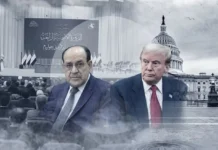
US President Donald Trump has publicly opposed Al-Maliki’s potential return to office, asserting that Iraq would have “zero chance of success, prosperity, or freedom” under his administration and warning that Washington “will no longer help Iraq” if he is chosen.
Read more: Nouri Al-Maliki’s return rekindles Iraq’s divisions as Iran and the US pull apart
https://www.shafaq.com/en/Iraq/Iraq-s-SLC-defies-pressure-over-Al-Maliki-PM-nomination
Al-Awadi: Implementing The ASYCUDA System Is A Global Commitment To Prevent Currency Smuggling And Correct The Trade Path
Baghdad (INA) – Government spokesman Basim al-Awadi affirmed on Tuesday that the implementation of the global electronic automation system ASYCUDA represents an international commitment and a reformative step to combat money laundering. He also noted that the recent urgent government decisions regarding goods at ports were issued to facilitate procedures for traders and alleviate financial burdens.
Al-Awadi told the Iraqi News Agency (INA): “The ASYCUDA system is a global electronic automation system issued by the United Nations Conference on Trade and Development (UNCTAD), and it is currently implemented in 102 countries worldwide.” He explained that “the system is not a local innovation but rather an international commitment within Iraq’s obligations to combat currency smuggling and money laundering. Its implementation also aims to ensure fairness in commercial competition.”
Al-Awadi acknowledged “delays and confusion at the ports that coincided with the start of the system’s implementation, leading to delays in the arrival of goods.” He noted that “the government took immediate decisions to address this confusion, including completely eliminating the government’s share of port storage fees and reducing the investment partner’s fees by 50%.”
He added that “Prime Minister Mohammed Shia’ al-Sudani directed the facilitation of goods release and the provision of necessary support to importers to overcome the technical obstacles they faced,” pointing out that “the government views the private sector as an essential part of the country’s economic and financial cycle.”
The government spokesperson refuted rumors linking the implementation of these regulations to a lack of state liquidity, emphasizing that they are “purely regulatory steps aimed at reform.” He stressed that “the government’s doors are open, in coordination with unions and federations, to address any injustices or shortcomings that may arise during the system’s practical application.” https://ina.iq/ar/economie/255285-.html
Zebari: No President Can Task Maliki With Forming The Government
Baghdad – One News Hoshyar Zebari, a member of the political bureau of the Kurdistan Democratic Party, dropped a bombshell regarding the nomination of Maliki for the next prime ministership.
Zebari indicated that regional circumstances and the large gatherings in the Gulf will make it difficult for any new president of the Republic of Iraq, whether from the KDP or PUK, to task Nouri al-Maliki with forming the government, given all the rejection announced by Donald Trump. He emphasized that the coordination framework raised the question with the White House twice and received the same negative answer.
He added that information coming from Washington indicates that the Americans are urging Baghdad to form a new government. https://1news-iq.net/زيباري-أي-رئيس-جمهورية-لا-يستطيع-تكليف/