Tishwash: Parliamentarian: The session to elect the President of the Republic will proceed as scheduled, and absence will cost one million dinars.
MP Nour Al-Bajari, from the “Al-Hasam” parliamentary bloc, confirmed on Tuesday that the Speaker of Parliament informed members of Parliament during Monday’s session that next Saturday’s session, dedicated to electing the President of the Republic, will proceed as scheduled and will be held on time.
Al-Bajari told Shafaq News Agency that “the Speaker of Parliament informed the MPs that Saturday’s session will proceed as scheduled and will be held to elect the President of the Republic.”
He added that “the Speaker of Parliament informed members of Parliament that MPs who are absent from the session to elect the President of the Republic will be officially marked absent and one million dinars will be deducted from their salaries.”
He pointed out that “there is confirmation from the Speaker of Parliament and the heads of the political blocs that the session to elect the President of the Republic will be held on its scheduled date.”
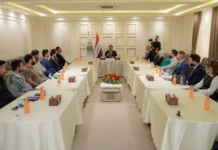
The Speaker of Parliament announced that April 11th has been set as the date for holding a session to elect the President of the Republic, following an extensive meeting with the heads of parliamentary blocs to discuss a number of issues related to the work of the Council.
The presidency stated that the meeting discussed “the issue of electing the president of the republic and the importance of proceeding with the completion of this constitutional entitlement and ending the state of political deadlock,” before deciding to set Saturday, April 11, as the date for holding the election session. link
***********
Tishwash: Britain is withdrawing its forces and canceling the deployment of military personnel in Iraq for fear they could become targets for Iran.
The British newspaper i revealed that British military personnel have been evacuated from their duties in Iraq, against the backdrop of escalating tensions between the United States and Iran.
The newspaper quoted a military source as saying that the British Ministry of Defence had withdrawn a number of its personnel from Iraq and had also cancelled the deployment of forces that were scheduled to participate in military exercises as part of operations against ISIS.
The source explained, according to the newspaper, that the decision came as a result of “the high level of risk,” whether in terms of the safety of individuals or the strategic risks associated with the presence of British forces within the American military system, which may make them vulnerable to targeting.
According to the report, British forces in Iraq had previously shot down Iranian drones during recent confrontations, with one strike coming within 400 meters of their positions last month.
The report noted that NATO had taken a similar step last month, withdrawing its advisory mission from Iraq and moving hundreds of its personnel to bases in Europe, following attacks targeting allied forces in the north of the country.
British forces are deployed in strategic locations in the Middle East, including a naval base in Bahrain with about 300 personnel, in addition to the participation of about 200 soldiers in supporting Iraqi and Kurdish forces through training and advising. link
*************
Tishwash: A Malaysian ship carrying one million barrels of Iraqi oil crosses the Strait of Hormuz
The Malaysian Foreign Ministry in Kuala Lumpur said on Tuesday that a Malaysian ship had safely crossed the Strait of Hormuz and was now continuing on its way to its final destination.
Iran effectively closed this vital sea lane, through which a fifth of the world’s oil and liquefied natural gas flows pass, in response to the US and Israeli air strikes that began in late February.
The Malaysian Foreign Ministry confirmed in a statement that one of the seven Malaysian-owned commercial vessels stranded in the Strait of Hormuz due to the Iran war has been granted safe passage.
The ministry did not mention the name of the ship, its final destination, or whether it was carrying a cargo.
The ministry said, “This positive outcome follows high-level diplomatic efforts,” including a phone call between Malaysian Prime Minister Anwar Ibrahim and Iranian President Masoud Pezeshkian late last month.
The Iranian embassy in Kuala Lumpur stated in a social media post on Monday that the first Malaysian ship had crossed the Strait of Hormuz.
Data from the London Stock Exchange Group and Kpler showed that the oil tanker “Ocean Thunder,” chartered by Petco, a unit of Malaysian state energy company Petronas, crossed the strait near the Iranian coast loaded with Iraqi crude.
Kpler data showed that the tanker was loaded with about 1 million barrels of Basra Heavy crude on March 2, and is expected to unload its cargo in Pengerang, Malaysia in mid-April link
Tishwash: Iraq has fallen out of the economic equation… Huge reserves with no trace, and the dinar faces ongoing challenges – Urgent
Economic expert Duraid Al-Anzi confirmed on Wednesday (April 8, 2026) that Iraq’s gold reserves do not play a direct role in improving the performance of the local economy, noting that they are effectively isolated within the management of the Central Bank and are used primarily to enhance its international standing.
Al-Anzi explained in a statement to “Baghdad Today” that Iraq possesses one of the most prominent gold reserves in the Arab world, and occupies advanced positions compared to a number of countries, but this has not been reflected in its credit rating, which is still within the (B) category, reflecting a clear gap between the size of the reserve and the overall economic performance.
He explained that owning gold gives the Central Bank of Iraq financial strength, and may indirectly support the dinar within the local market, but it has not succeeded in strengthening the position of the Iraqi currency globally, as the dinar is still among the weakest currencies, and the effect of the reserve is limited to achieving limited internal stability.
He pointed out that the relationship between the government and the central bank is governed by a strict legal framework that prevents the use of reserves, whether gold or cash, to finance the deficit or support the budget, except in exceptional cases that require special legislation, such as severe crises related to the cessation of oil revenues.
He added that the dollar reserve, which exceeds $100 billion and is deposited with international financial institutions, is subject to strict restrictions and controls, and cannot be used freely to address internal crises, which reduces the government’s ability to rely on it as a direct solution.
He stressed that addressing the financial crises in Iraq cannot rely on cash or gold reserves, but requires activating internal revenues such as taxes, customs and fees, in addition to combating corruption and reducing financial waste, noting that there are internal files that can contribute to solving the crisis within a short period if they are managed seriously.
Al-Anzi cited the experiences of countries such as Lebanon, Turkey and Iran, which have large gold reserves, but at the same time suffer from severe monetary crises, which confirms that gold does not represent a direct solution to economic crises.
He added that the impact of Iraq’s gold reserves remains symbolic and indirect, and cannot be relied upon as a tool to address financial or monetary crises, considering that employing it in this way is not in line with sound economic principles.
The economies of countries, including Iraq, rely on a mix of financial and monetary tools to achieve stability. Gold reserves are one element of financial strength, but they are often used as currency cover or to boost international confidence, rather than as a direct tool for addressing crises.
Given the Iraqi economy’s heavy reliance on oil revenues, challenges remain in diversifying income sources and strengthening non-oil sectors, meaning any decline in oil prices or revenues will directly impact financial stability. link