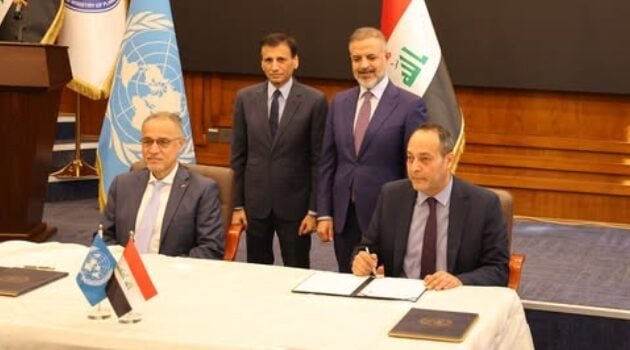
The Government of Iraq and the United Nations on Thursday signed the United Nations Sustainable Development Cooperation Framework (UNSDCF) for the period 2025–2029, marking a new phase in their partnership focused on long-term development and institutional reform.
The signing ceremony was attended by Deputy Prime Minister and Minister of Planning Dr. Muhammad Ali Tamim and the Special Representative of the UN Secretary-General and Head of the United Nations Assistance Mission for Iraq (UNAMI), Mohamed Al-Hassan.
The agreement was signed on behalf of the Iraqi government by Dr. Tamim, while Mr. Ghulam Mohammad Isaczai, Deputy Special Representative and UN Resident and Humanitarian Coordinator, signed on behalf of the United Nations.
The UNSDCF aligns with Iraq’s National Development Plan 2024–2028 and Vision 2030 and is built around four strategic priorities:
- Improving access to education, health, and social services, with a focus on women, children, and displaced families
- Promoting jobs and economic growth, including youth and women’s empowerment and support for sustainable and green economic initiatives
- Protecting the environment and addressing climate change, through better resource management, climate adaptation, and disaster risk reduction
- Strengthening good governance and the rule of law, by enhancing public institutions, justice, social cohesion, and peacebuilding
Dr. Tamim said the framework reflects Iraq’s commitment to building a better future for its citizens, stressing that cooperation with the United Nations will help combine resources, expertise, and programs to advance national priorities and meet the 2030 Sustainable Development Goals.
For his part, Al-Hassan described the agreement as a natural and honorable transition in relations between Iraq and the UN, shifting from political stabilization efforts toward a consolidated partnership focused on sustainable development.
Isaczai stated that the framework opens a new chapter following the drawdown of UNAMI and the gradual phase-out of humanitarian activities, emphasizing that UN support will now center on policy advice, technical expertise, and socio-economic development.
Implementation of the UNSDCF will be overseen by a High-Level Joint Steering Committee co-chaired by the Ministry of Planning and the UN Resident Coordinator. Progress will be reviewed annually, supported by a dedicated Partnership Fund and a resource mobilization strategy to ensure sufficient financing.