Tishwash: Zidane: The parliamentary session on December 29th will decide on the presidency of the council and cannot be extended.
The head of the Supreme Judicial Council, Faiq Zaidan, confirmed that the session of the new House of Representatives scheduled for December 29 must end with the appointment of the Speaker of the Council and his two deputies, noting that it is not constitutionally or legally possible to postpone or extend it.
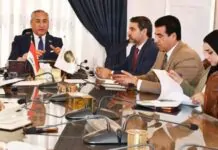
A statement from the judiciary, a copy of which was received by Al-Furat News, stated that: “This came during the reception of the President of the Supreme Judicial Council, Faiq Zaidan, on Saturday, by the President of the Patriotic Union of Kurdistan Party, Bafel Talabani.”
He added, “During the meeting, emphasis was placed on the importance of respecting the constitutional timelines for electing the three presidencies, in order to ensure the completion of the formation of the legislative and executive authorities.”
Zaidan explained that “the first session of the new House of Representatives on 29/12/2025 must end with the appointment of the Speaker of the House of Representatives and his two deputies, and it is not constitutionally or legally possible to postpone or extend it.”
Ziad also stressed “the importance of deciding on the nomination of the candidate for the presidency of the republic within the constitutional period of thirty days after the election of the Speaker of Parliament on the 29th of this month.” link
Tishwash: Savaya travels to Baghdad to discuss the nature of the relationship between Washington and Baghdad in the next phase.
An informed government source revealed on Sunday that the US President’s envoy, Mark Savaya, will soon visit Baghdad at the head of a delegation from the US administration to discuss a number of issues related to the nature of the relationship between Washington and Baghdad in the next stage, as well as to discuss solutions to the crises.
The source told Shafaq News Agency that “US envoy Mark Savaya, accompanied by a number of US officials, will visit Baghdad soon to meet with a number of officials in the Iraqi government and various political leaders, to discuss important issues concerning developments in the Middle East and its stability, in addition to economic dealings and partnerships, US investment, and the priorities of the stage, most notably the political and security files for Iraq and the region in general.”
He added that “the delegation will also discuss mechanisms to expand the scope of partnership and political consensus regarding some visions concerning the regional situation, and proposals for solutions to address crises and challenges,” indicating that “Safaya will carry with him American messages to the Iraqi forces, including the results of work on some issues and files agreed upon between Baghdad and Washington, and the upcoming visions for formulating a real partnership, specifically regarding the withdrawal of American forces according to the specified timetables, in addition to how to deal with the next stage based on the security partnership and arming the Iraqi forces, and the armament plans.”
Last October, US President Donald Trump decided to appoint Mark Savaya as special envoy to Iraq .
Mark Savaya is the third US envoy to Iraq since Paul Bremer in 2003, and after Brett McGurk, during the war against ISIS in 2014.
Savaya has stirred controversy through his recent writings, in which he explicitly called for an end to the armed factions and for them to be prevented from participating in the government, as well as issuing warnings to Iraq and cautioning against a return to a “cycle of complications”.
Yesterday, Saturday, some armed factions announced their agreement to the call to restrict weapons to the state, and official positions were issued by the Secretary-General of the Imam Ali Brigades, Shibl al-Zaidi, followed by a call from the Secretary-General of the Asa’ib Ahl al-Haq Movement, Qais al-Khazali, as well as the Ansar Allah al-Awfiya faction, in addition to the spokesman for the Sayyid al-Shuhada Brigades.
The head of Iraq’s Supreme Judicial Council, Faiq Zaidan, announced yesterday that armed factions had responded to the call to restrict weapons to the state.
However, Kataib Hezbollah issued a statement rejecting its “disarmament” and affirming that “sovereignty, controlling the security of Iraq, and preventing foreign interference in all its forms are prerequisites for discussing the state’s monopoly on weapons. We affirm that our position is consistent with what our religious authorities have stated, whenever that is achieved link
***************
Tishwash: After the prime minister’s name was decided, the coordination framework moved to negotiating the government program.
Non-controversial
The atmosphere of the movement within the Coordination Framework, the broader umbrella for Shiite political forces in Parliament, is moving towards a crucial stage, the title of which is agreeing on a name and program for the next Prime Minister
In an attempt to produce a candidate who can manage the next stage and open the door to understanding with the rest of the political forces within the framework of constitutional entitlements and political calming, which seems to have decided on the name of the Prime Minister internally, to move practically to negotiating the government program and its priorities before the official announcement of the candidate.
Salam Al-Zubaidi, a member of the Coordination Framework, confirmed to Baghdad Today that “the intensive meetings and gatherings held by the Framework’s forces are witnessing remarkable progress in viewpoints, and there is a broad understanding on the need to choose a figure capable of managing the next stage efficiently and achieving political and service stability, while taking into account the country’s supreme interest.”
Al-Zubaidi explained that “the discussions are not limited to names only, but also include the government program and executive work priorities, foremost among them improving the economic situation, supporting security and stability, and enhancing public confidence in official institutions, and agreement on these files is proceeding in parallel with the naming file.”
According to political data obtained by “Baghdad Today,” most of the figures close to the coordinating framework, who appear on political programs on television, confirm in their talks that “the decision has already been made,” and that the candidate is a figure from the Middle Euphrates region, a graduate of Baghdad University, and does not provoke a sharp dispute among the main Shiite forces.
These data indicate that the current discussion is focused on the details of the government program, which was likely formulated primarily in agreement with the candidate himself, and that the ongoing dialogues aim to incorporate the observations of the various forces before announcing the final version.
Al-Zubaidi added that “the positive atmosphere prevailing in the dialogues reflects the keenness of all parties to avoid disputes and move towards a genuine consensus that leads to the formation of a strong government capable of facing internal and external challenges, and the next few days may witness an official announcement of the name of the candidate for the premiership.”
The member of the coordinating framework concluded by saying that “the current stage requires calming down and clearly prioritizing the logic of dialogue and understanding, and the framework is proceeding with completing the constitutional entitlements in accordance with the legal contexts and in a way that fulfills the aspirations of the citizens.”
Three key factional figures broke the scene in the past few hours with similar statements, in which they expressed their readiness to hand over weapons and confine them to the hands of the state, in a move that is read – according to political sources – as one of the signs of paving the way for the new political stage, and an early message of support for the next government and its supposed security program.
The political arena is witnessing intense activity to resolve the issue of forming the new government, amid popular anticipation of the process of choosing the next Prime Minister, and whether he will be able to manage the economic and service crises and reduce the severity of political tension, after previous government experiences marred by disputes and the failure to implement reform programs. link