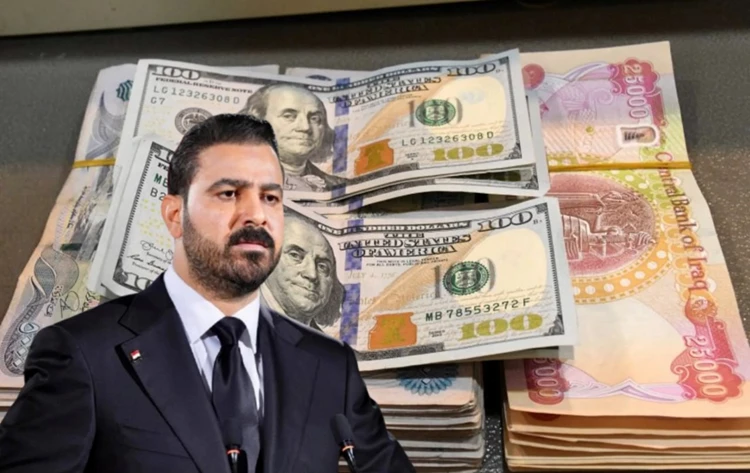
Several Iraqi provinces are preparing for demonstrations and protests following the government’s recent decision to raise the dollar exchange rate to 150,000 dinars per 100 dollars. Many fear the move will lead to higher prices for goods and services across the country, placing additional pressure on ordinary citizens.
The government has defended the decision as part of efforts to address revenue shortages and increase state resources. However, political figures, economists, and legal experts have criticized the measure, arguing that it will increase living costs and place the burden on average Iraqis.
Former Parliamentary Economy and Investment Committee member Yasser al-Husseini said the real problem is the gap between the official exchange rate and the parallel market rate. He argued that corrupt networks have benefited from this difference at the expense of citizens.
According to al-Husseini, market stability can only be achieved by unifying the official and parallel exchange rates. He added that strengthening local industries would also help reduce the country’s dependence on imports and lessen the impact of currency fluctuations.
He said closing the gap between the two exchange rates would require long-term reforms that could take two to three years. These reforms include expanding electronic payments, reducing cash transactions, increasing digital banking services, and deploying more ATMs throughout the country.
Economic expert Rashid al-Saadi strongly criticized the decision, describing it as unfair and harmful to low-income families, the poor, and small businesses. He warned that higher exchange rates would encourage traders to increase prices, making food and essential goods more expensive.
Al-Saadi argued that the government should instead focus on reducing public spending, tackling ghost employees, ending multiple salary payments, cutting unnecessary government expenses, and reducing spending on official privileges, travel, fuel, and security details.
He warned that increasing the dollar exchange rate during a period of economic hardship could have serious consequences for ordinary citizens and further weaken their purchasing power.
Meanwhile, legal expert Ali al-Tamimi said the new exchange rate decision could potentially face legal challenges before the Federal Supreme Court.
He noted that the court previously upheld the independence of the Central Bank and rejected earlier challenges to exchange rate policies. However, he said the latest decision could be contested if it is shown to conflict with the Central Bank Law, which prioritizes price stability, or with constitutional protections related to citizens’ welfare.
Al-Tamimi suggested that Parliament could address the issue through several constitutional mechanisms, including amending the relevant budget provisions, questioning the Central Bank governor, and filing a legal challenge before the Federal Supreme Court with support from a significant number of lawmakers.
As criticism continues to grow, the exchange rate decision is becoming one of the most debated economic issues in Iraq, with concerns that rising prices could trigger wider public protests in the coming weeks.