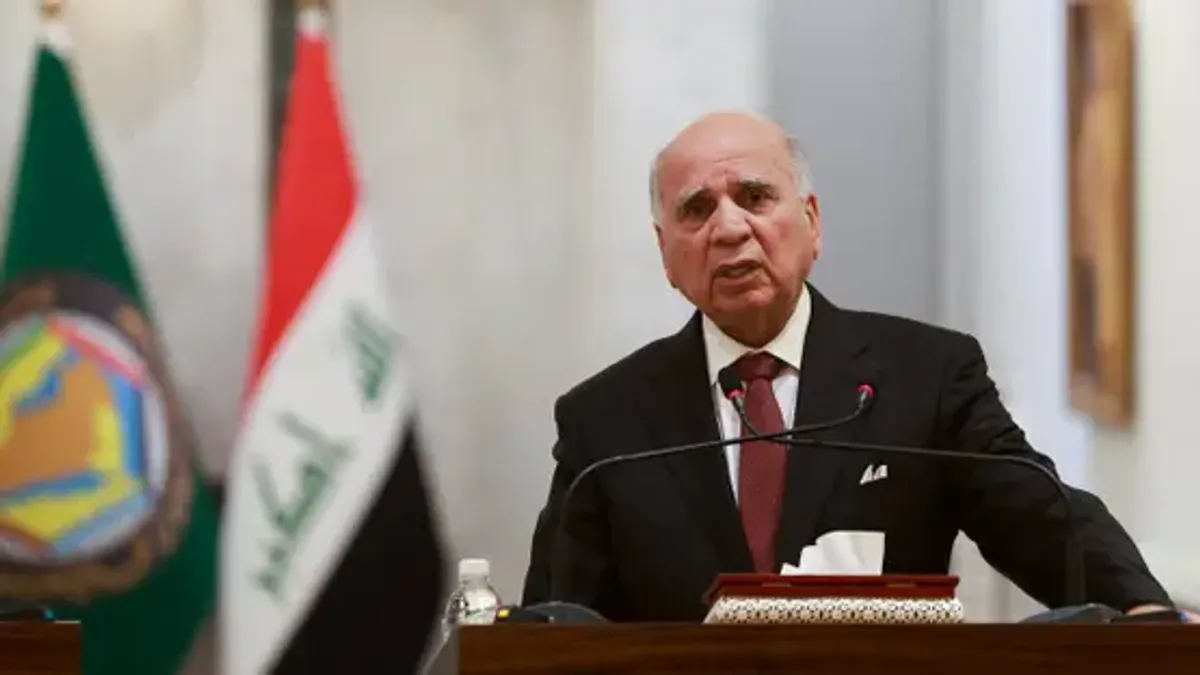
Iraqi Foreign Minister Fuad Hussein said the government has begun implementing a plan to bring weapons held by armed factions under state control, with a timeline extending until June 2027.
Speaking to journalists at the Iraqi Embassy in Washington, Hussein said that three of the seven factions included in the plan have already announced their support for Prime Minister Ali Al-Zaidi’s policy and have started handing over weapons to the Iraqi armed forces. He added that other groups, including the Sayyid al-Shuhada Brigades, are expected to join the process soon.
Hussein described the initiative as a constitutional Iraqi commitment aimed at ending the issue of weapons outside state control. He said the plan has broad support among Iraq’s political leadership, regardless of external pressures.
On security relations with the United States, Hussein said the end of the international coalition’s mission creates an opportunity for Iraq to build direct bilateral security partnerships with the U.S., Britain, France, and other countries under the Strategic Framework Agreement between Baghdad and Washington. electrical
Regarding regional diplomacy, Hussein said Iraq maintains relations with both the United States and Iran and supports efforts to reduce tensions through dialogue. He noted that Baghdad is coordinating with other mediators, including Oman, Qatar, and Pakistan, and is prepared to play a direct mediation role if both sides request it.
On security within Iraq, Hussein stressed that the Peshmerga are a constitutionally recognized part of Iraq’s defense system. He said there is close coordination between Peshmerga and federal forces in disputed areas such as Kirkuk and Diyala to prevent ISIS from exploiting security gaps.
He also revealed ongoing cooperation with Saudi Arabia regarding the investigation into attacks on Saudi pipelines. According to Hussein, preliminary findings indicate the attack originated from Iraqi territory about 13 kilometers from the Iranian border, and Iraq has requested additional information from Tehran.
Discussing relations with Türkiye, Hussein said Baghdad and Ankara have held talks regarding the Turkish military presence in Bashiqa and Sinjar. He noted that understandings have been reached concerning a gradual withdrawal of Turkish forces from Bashiqa within a specified timeframe.
On oil exports, Hussein warned that tensions in the Strait of Hormuz pose risks to Iraq’s exports, which currently total about 3.5 to 3.6 million barrels per day through the waterway. As a result, Iraq is reviewing alternative export routes through neighboring countries.
He said Baghdad has held extensive discussions with Syria about reviving the Iraqi oil pipeline to the Syrian port of Banias. He also cited interest from international companies, including Chevron, as well as Gulf investors. Iraq is also continuing discussions on the planned pipeline to Jordan’s port of Aqaba.
Hussein added that exports through the Kurdistan Region pipeline to the Turkish port of Ceyhan have resumed after previous legal disputes. Current exports are around 200,000 barrels per day, with plans to increase them to 350,000 barrels per day and eventually 700,000 barrels per day as foreign oil companies expand production.
On energy, Hussein said Iraq continues to import Iranian gas under agreements dating back to 2013 and previously imported around 1,200 megawatts of electricity from Iran, though supplies have faced disruptions.
To reduce dependence on external energy sources, Iraq is investing in domestic gas production and expanding regional electricity connections. The country has already begun importing electricity through Jordan and is pursuing interconnection projects with Egypt, Türkiye, and Gulf countries through Kuwait.
Hussein said he has been coordinating with Kuwaiti officials to advance the Gulf electricity interconnection project and support future energy supplies to Iraq.
His remarks come after Prime Minister Ali Al-Zaidi officially announced the end of the international coalition’s mission in Iraq. The government has separated the issue of coalition withdrawal from its plan to bring faction weapons under state control.
According to the government’s plan announced on September 21, a 90-day truce is currently underway, during which factions will refrain from attacks in exchange for assurances that they will not be targeted by U.S. strikes. The weapons handover process is then scheduled to continue through June 30, 2027.
Available next action: Create a downloadable PDF file here in this chat containing the finalized decisions and immediate actions above