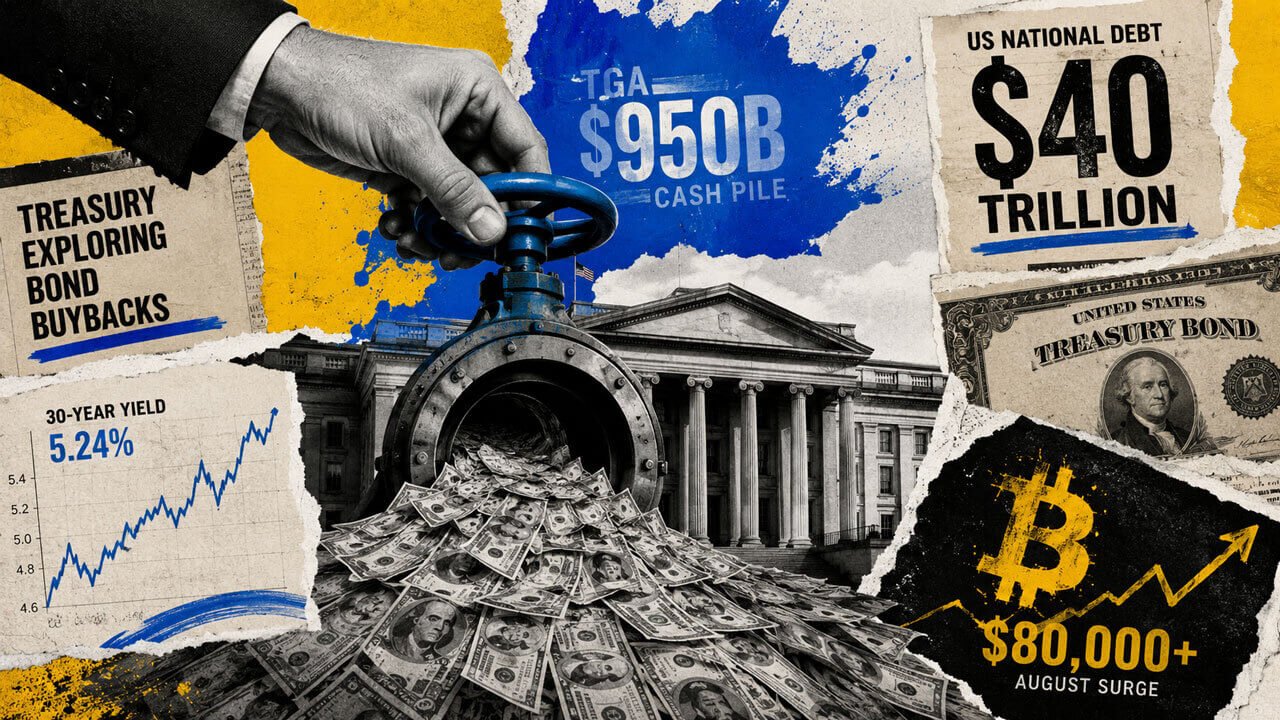
The US 10-year Treasury yield reached 5.2% during trading on Sept. 24, putting more pressure on financial markets as oil prices rose and the possibility of another Federal Reserve rate hike remained on the table.
The 10-year yield reached 5.20% during the session after closing at 5.11% the previous day. The 30-year Treasury yield also climbed to 5.47%, its highest level since 2004.
At the same time, Bitcoin was trading near $84,000 after falling from around $87,000 earlier in the week. So far, the pullback has been limited, but investors are watching whether crypto demand can continue if bond yields remain high.
Oil prices were one reason Treasury yields moved higher. Brent crude settled at $106.60 a barrel, up $3.52, while WTI ended at $94.61, gaining $2.45. Oil prices later moved lower from their daily highs after reports of US-Iran discussions about reopening the Strait of Hormuz.
Higher oil prices have added to concerns about inflation. Philadelphia Fed President Anna Paulson said underlying inflation was around 2.5% to 3%, still above the Fed’s 2% target. She supported the recent quarter-point rate hike and said another increase could be needed if the economy develops as expected.
New York Fed President John Williams also said another rate hike before the end of the year was a reasonable possibility, although he stressed that the decision would depend on incoming economic data.
The Fed raised its benchmark interest rate to 3.75%–4.00% on Sept. 16, while its latest projections showed that another increase could still happen this year.
Recent economic data has also kept the debate open. Weekly jobless claims fell to 197,000 for the week ending Sept. 19. Meanwhile, the US composite PMI rose from 56.0 in August to 58.4 in September, showing the strongest business activity growth in more than five years.
Bitcoin has shown some strength despite the higher yields. It moved above $82,000 after the Fed decision and later reached the $87,000 area before pulling back toward $84,000.
There are also signs of continued buying. Wallets holding between 100 and 1,000 BTC accumulated about 113,950 BTC between July 15 and Sept. 24. US spot Bitcoin ETFs also recorded their fifth straight session of net inflows on Sept. 23.
However, ETF demand has not been consistent throughout the month. Bitcoin ETFs recorded only about $6.1 million in net inflows during the week of Sept. 14–18, even though they brought in $433 million on the final trading day of that week.
Bitcoin’s recent rally came from several sources, including spot buyers, ETF investors and traders closing short positions. The move showed that the latest Fed rate hike did not immediately stop demand for Bitcoin. But with Treasury yields now higher, investors will be watching whether that demand can continue.
US stocks were relatively stable on Sept. 24. The S&P 500 slipped 0.02%, the Nasdaq gained 0.01%, while the Dow Jones fell 0.31%.
Crypto also continues to face regulatory uncertainty in the US. The Senate failed to advance the Digital Asset Market CLARITY Act on Sept. 15 after a 49–50 procedural vote. The bill needed 60 votes to move forward.
The bill would establish clearer rules for digital assets and define the responsibilities of the SEC and CFTC. Seven Senate Democrats later reopened discussions, but no new vote has been scheduled.
While the legislation remains stalled, regulators are continuing to act under their existing powers. The CFTC submitted proposed crypto market rules for White House review on Sept. 18, while the SEC has provided an exemption covering certain tokenized securities activity.
These steps may provide some guidance to the industry, but they do not replace a broader market structure law. For now, crypto investors are watching two major factors at the same time: whether Treasury yields continue rising and whether lawmakers can eventually agree on new digital asset rules.