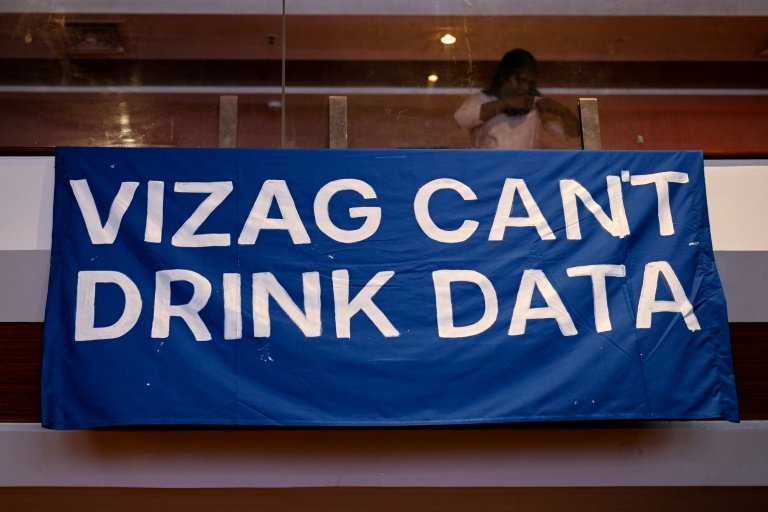
Google’s planned $15 billion investment in a massive AI data centre in Visakhapatnam, India, has faced opposition from residents worried about its impact on the environment, electricity supplies and local communities.
The facility in Andhra Pradesh is expected to become operational in 2028. Google says it will use advanced air-cooling technology instead of water cooling because the surrounding area is already facing pressure on its water resources.
Alexander Smith, Google’s head of infrastructure and energy for the Asia-Pacific region, said the company takes local concerns seriously and conducts environmental assessments before beginning construction.
These assessments cover electricity supply, grid stability, water risks, wildlife and ecosystems, noise and other potential impacts.
“If there is insufficient power in a location, or if operating a data centre would mean taking power away from a community, Google will either find ways to develop more power, or it will not build there,” Smith said.
The facility is set to become Google’s largest AI hub outside the United States. It is also part of a wider wave of data centre development planned for Visakhapatnam.
However, environmental activists want Andhra Pradesh to pause new data centre projects until there is clearer evidence of their effects on local communities and the environment.
Smith described the project as a long-term commitment, saying Google has a responsibility to ensure that nearby communities, electricity networks and water resources benefit from its presence.
Google explains its water and electricity plans
The rapid growth of artificial intelligence has increased demand for data centres, which require large amounts of electricity to run servers and computing equipment.
Critics argue that these facilities could put additional pressure on electricity grids that still depend heavily on fossil fuels. They also worry that cooling systems could increase demand for water in areas where supplies are already limited.
Google said its assessment of Visakhapatnam identified pressure on the local watershed. As a result, the company selected advanced air cooling rather than water-based cooling for the facility.
For freshwater used for purposes other than cooling, Google has committed to replenishing 120% of the water it consumes across its operations by 2030.
The company has not disclosed the data centre’s specific power capacity. However, Smith said Google would fully fund the cost of necessary electricity infrastructure upgrades.
He also said the company plans to invest in new clean energy projects in Visakhapatnam beyond what regulations require.
Why Google selected Visakhapatnam
Google considers several factors when choosing locations for its data centres, including access to customers, skilled workers, clean energy opportunities and partnerships with local communities.
Smith said Visakhapatnam offers a combination of these advantages that is difficult to find elsewhere.
The city’s coastal location is another benefit. Undersea cables can connect Visakhapatnam with South Africa and Australia, potentially strengthening Andhra Pradesh’s position as India’s third major subsea cable hub.
However, concerns about the project’s environmental impact remain. Residents have protested against the development, while a separate dispute in Finland recently led authorities to halt work at two Google data centre sites pending required environmental assessments.
Google expects the project to create thousands of jobs
Opponents of large data centres argue that these projects do not always deliver enough lasting benefits to the communities where they are built.
Google says the Visakhapatnam development is projected to generate approximately $688 million in local economic activity each year.
Smith added that every job inside a Google data centre supports nine additional jobs in the surrounding community.
During a typical three-to-five-year construction period, an average Google data centre project employs around 4,200 construction workers annually, according to the company.
Once operational, each facility is designed to run for at least 20 years and support hundreds of specialist on-site positions.
The project’s long-term impact will depend on how effectively Google delivers on its commitments to local employment, clean energy and responsible water use while addressing concerns raised by residents.
For now, Google says its air-cooling system, investment in power infrastructure and planned clean energy projects are intended to reduce the pressure its AI facility could place on Visakhapatnam’s existing resources.