Tishwash: Baghdad in talks with Erbil to export oil through its pipelines, says oil minister
Abdul Ghani said Thursday that oil production has diminished from over four million barrels per day to merely 1.4 million because of the war.
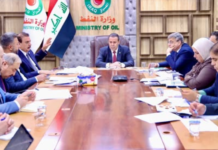
ERBIL, Kurdistan Region of Iraq – Baghdad is in talks with Erbil to export some of Kirkuk’s oil through the Kurdistan Region’s pipelines with Turkey, Iraq’s oil minister said Saturday, coming as the Iran war has severely disrupted exports through the Gulf.
Iraqi oil minister Hayyan Abdul Ghani told The New Region that federal government is in talks with the Kurdistan Regional Government (KRG) to transfer oil from the Region’s pipelines to Kirkuk’s Ceyhan pipeline, which flows into Turkey, to resume exports from the key conduit
Since the US and Israel launched their military campaign against Iran in late February, Tehran in retaliation has targeted neighbouring countries and shut the Strait of Hormuz, a key waterway responsible for one fifth of the world’s oil.
Iraq has been severely affected by the disruption in oil transport through the Gulf.
“We are optimistic about reaching an agreement to transport oil through this method, until the ministry completes the renovation and repair works on the North Oil Company pipeline,” Abdul Ghani added.
US President Donald Trump on Saturday said that “many Countries, especially those who are affected by Iran’s attempted closure of the Hormuz Strait, will be sending War Ships, in conjunction with the United States of America, to keep the Strait open and safe.”
Abdul Ghani said Thursday that oil production has diminished from over four million barrels per day to merely 1.4 million because of the war.
There have also been multiple attacks on tanker ships in the Gulf since the war started, including in Iraqi waters.
In the early hours of Thursday, two Marshall Islands- and Malta-flagged tankers were targeted within Iraqi territorial waters. One crew member was killed, and 38 others were rescued by Iraqi authorities, according to state media.
Baghdad has previously requested to export oil through the Kurdistan Region’s oil pipeline to allow for exports and cash access. However, Iraq’s continued trade embargo on the Kurdistan Region since the start of the year has prevented reaching a deal, according to a senior KRG official.
“Baghdad has enforced a complete trade embargo on the Kurdistan Region since January 1 this year. It has crippled our economy and finances and is existential for the Region,” the official told The New Region.
The official stated that the KRG would welcome Baghdad’s use of the pipeline, “but this embargo must be lifted too, even as temporary relief for the whole country until a long-term deal has been settled. We want to be helpful, especially to our US partners.”
“Iraq faces an unprecedented fiscal and economic crisis. Baghdad should be doing everything in its power to facilitate trade and exports — not stifle them,” they added.
The current disruption may also make it difficult for Iraq to pay civil servant salaries.
Iraq’s monthly oil revenues are deposited into its account at the US Federal Reserve, which are normally transferred back to the country accordingly.
In January and February, none of the revenue came through; a transfer was scheduled for the beginning of March, but after flights were suspended due to the US-Israeli war on Iran, the transfer route was cut off. link
************
Tishwash: Trump Announces Multinational Effort to Open and Secure Hormuz Strait
U.S. President Donald Trump stated that several countries will send warships to the Hormuz Strait to make it “open and safe.”
Following military operations involving the United States, Israel, and Iran, now in its third week, the Iranian Revolutionary Guard declared the strait closed earlier this month to most commercial traffic.
The closure of the Strait has triggered a global energy crisis, causing oil prices to surge past $100 per barrel and forcing a 97% drop in regional maritime traffic.
Countries to Join US in Securing Hormuz Strait Despite Iran Threat
“Many countries, especially those who are affected by Iran’s attempted closure of the Hormuz Strait, will be sending warships, in conjunction with the United States of America, to keep the Strait open and safe,” Trump wrote on Truth Social on Saturday.
He noted that although Iran’s military capability is fully destroyed, they can still easily send drones, drop mines, or launch missiles along the waterway.
Trump Calls for International Support to Open Strait
“Hopefully China, France, Japan, South Korea, the UK, and others that are affected by this artificial constraint will send ships to the area so that the Hormuz Strait will no longer be a threat by a nation that has been totally decapitated,” he added.
Trump said the United States is currently attacking “the hell out of the shoreline and continually shooting Iranian boats and ships out of the water. One way or the other, we will soon get the Hormuz Strait OPEN, SAFE, and FREE!”
Iran Vows to Keep Strait Blocked; U.S. Prepares
In his first public statement since succeeding his father, the new Supreme Leader, Ayatollah Mojtaba Khamenei, announced last week that the “lever of blocking the Strait of Hormuz must continue to be used.”
The Revolutionary Guard also maintained that not “a liter of oil” will pass for the U.S. or its allies, and any vessel linked to them will be considered a “legitimate target.”
Earlier, Pentagon chief Pete Hegseth said the Washington is prepared for possible Iranian efforts to block the waterway, working on clear objectives and strategies.
Meanwhile, General Dan Caine called the strait “a tactically complex environment,” emphasizing that military escort operations should align with broader strategic goals before any large-scale action. link
Tishwash: With the disappearance of 10 Iraqi ministers, Baghdad’s economy has entered a war and will survive on only one million barrels!
Summary by expert Mahmoud Dagher
Dr. Mahmoud Dagher, an academic and economist who held important positions at the Central Bank, presented a summary of the country’s financial situation with the escalation of the Fourth Gulf War. Iraq was the “first country to enter a state of war economy” after the disruption of oil supplies in the Strait of Hormuz and the attack on tankers in Khor Abdullah.
At best, it was no longer possible to export more than one million barrels (out of three and a half million barrels in the usual situation). He also pointed out that the government’s situation was a “political vacuum” as 10 of Mohammed al-Sudani’s ministers had become members of parliament while their ministries were currently being run by acting ministers, according to his observation during an interview with journalist Hanadi Sinan, which was followed by 964 Network.
Dr. Mahmoud Dagher:
25% of the world’s oil comes out of the Strait of Hormuz, so it is impossible to close this strait. This region is a vital artery for the global economy. Under the current circumstances, with the price of a barrel of oil reaching about $100, this poses a problem for the Western consumer in the United States, Canada, and elsewhere. Will Iran be allowed to control this strait? I believe that measures will be taken in the coming period, and it seems that the war will not end quickly.
Iraq is now the only country that will be greatly affected if the war lasts too long, and it is the only country that has entered a “war economy,” and it is necessary to take quick action.
Now we are in dire need of a government that can control the “rhythm,” as the situation is currently very difficult, especially with a government in which 10 ministers have moved to the House of Representatives (their ministries are operating on an acting basis).
Oil exports, at best, can reach one million barrels. It is possible during the next two months to provide salaries through internal borrowing and also to benefit from reserves, but this does not mean that we are in a comfortable economic situation.
We have entered a “war economy” and we need someone to control the mechanisms of the war economy in terms of spending and revenue. link