Commander-In-Chief: The Government’s Focus On Security Forces Is A Cornerstone For Stability
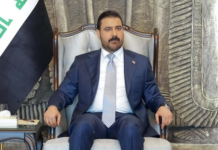
Iraqi News Agency, INA – BAGHDAD 5/29/2026 PM and Commander-in-Chief of the Armed Forces, Ali Faleh al-Zaidi, affirmed on Wednesday that the government’s focus on security forces is a cornerstone for stability and weapon control.
Al-Zaidi received on Wednesday several military and security commanders from various branches of the security forces, in the presence of the heads of the Intelligence and National Security services, the Chief of Staff of the Army, the Deputy Commander of the Joint Operations, and the undersecretaries of the Ministry of Interior, on the occasion of Eid Al-Adha Al-Mubarak, according to a statement from the PM Media Office, received by the Iraqi News Agency – INA.
The Prime Minister extended his “best wishes to the heroes of the security agencies and formations on the occasion of Eid,” commending their efforts and success in imposing security across all regions of the country and meeting various challenges.
He expressed his pride and appreciation for the significant efforts exerted by the armed forces and the distinguished level they have attained, which enables them to fulfill their national duties and assert their authority in consolidating stability.
The Commander-in-Chief of the Armed Forces stressed the government’s commitment to providing full support to the security forces, which constitute the fundamental pillar of imposing stability and restricting arms in the hands of the state.
“The prosperity Iraq enjoys today would not have been achieved without the sacrifices of the heroic martyrs and wounded, who gave everything to protect the country, preserve its gains, and fulfill the aspirations of the Iraqi people,” he added.
PM: Government Determined To Proceed With State-Controlled Weapons Project
Iraqi News Agency, Friday,29 May 2026 Baghdad – INA Prime Minister Ali al-Zaidi affirmed on Friday that the government is determined to proceed with the project to restrict weapons to the state.
The Prime Minister’s Media Office stated in a press release received by the Iraqi News Agency (INA): “Prime Minister Ali Falih al-Zaidi received today a group of tribal sheikhs and dignitaries who offered their congratulations on the occasion of Eid al-Adha.”
Al-Zaidi emphasized “his pride in the honorable tribes, which represent a social umbrella providing the state with the best talents and leadership and administrative personnel,” noting “the government’s commitment to supporting this social entity, which has been a pillar of the Iraqi state since its inception and a defender of it in the most difficult circumstances.”
The Prime Minister stressed that “the government is determined to proceed with the project to restrict weapons to the state, to prevent violations of the rule of law, to combat corruption, to strengthen Iraq’s power and sovereignty, and to pursue open regional and international relations for the benefit of Iraq—all principles called for by the Supreme Religious Authority.”
Al-Zaidi: We Are Proceeding With The Project To Restrict Weapons To The State Control
Iraqi News Agency, Thursday, 5/28/2026 / 19:46 INA–Baghdad 28 May 2026 Prime Minister Ali Faleh al-Zaidi affirmed on Thursday the government’s commitment to proceeding with the project, which has the support of the highest religious authority and stipulates that weapons be exclusively held by the state, and emphasized that the government wants the state to remain the sole entity authorized to possess weapons.
The Prime Minister’s Media Office said in a statement received by the Iraqi News Agency (INA) that “Prime Minister Ali Faleh al-Zaidi hosted a group of tribal sheikhs and dignitaries, exchanging greetings with them on the occasion of Eid al-Adha.”
“Al-Zaidi noted that tribes are the backbone of the state and its living history. They have played a significant role in resolving issues and problems, as they are the guardians of values and protectors of civil peace. They have been the first line of defense and have contributed to ending many conflicts and calls for division,” according to the statement.
Al-Zaidi reiterated the government’s commitment to the project, which has the support of the highest religious authority and stipulates that weapons be exclusively held by the state, while he stressed that “the government wants the state to be the sole entity authorized to possess weapons.”
“Al-Zaidi listened to the interventions and opinions of those present and expressed his pleasure at meeting this group of tribal sheikhs,” the statement continued.
“The Council of Tribes is a school for learning authentic values and principles,” Al-Zaidi stressed, calling for “reliance on three pillars: economic commitment, national belonging, and belief in the state,” because “Iraq needs unified voices during this critical stage to move the country forward.”
Al-Zaidi stressed that “the state alone must possess power; this is a decision, not an option,” emphasizing “the need to prevent the proliferation of weapons and their use in arbitrary practices and tribal conflicts.”
Al-Zaidi noted that Iraq is part of the international community, and we are committed to balanced relations, pointing to “efforts to establish an effective identity for Iraq and move away from centralized economic approaches by attracting international companies to invest.”
“We will not allow any extortion or obstruction of foreign companies operating in Iraq,” Al-Zaidi added, expressing his hope that “tribal sheikhs will play a greater role in addressing violations and protecting the country and its stability.”
“Iraq needs moderation in discourse and coexistence to secure the rights of its people,” he concluded.
Muqtada Al-Sadr Launches Saraya Al-Salam Handover To State
2026-05-29 Shafaq News- Najaf A committee appointed by Patriotic Shiite Movement (PSM) leader Muqtada Al-Sadr held its first meeting on Friday to implement the formal separation of its military wing Saraya Al-Salam from the movement,reviewing the procedures required to carry out the decision within the one-week timeframe set by Al-Sadr.
facebookالمكتب الخاص لسماحة السيد مقتدى الصدر
pdoerSstno56hi1hm357i4431a8igi26t39hl21tt4gl897mi039lf1ui2a8 ·
The Meeting Of The Committee Commissioned By His Eminence Commander Muqtada Al-Sadr (May Allah Be Glorified) About The Dissolution Of The Peace Secrets – Private Office / Al-Najaf Al-Ashraf
In accordance with the statement of His Eminence Commander Muqtada Al-Sadr (May Allah be glorified), which ordered the completion of the procedures of disbanding the military side of the Peace of the Shiite National Stream for a maximum of one week, the commission announced today, Friday the twelfth of the month of Dhu-Hajj 1447 corresponding to the 29th-ninth From May 2026, for the purpose of following up the completion of the procedures of dismantling the military side of the Peace Army from the National Shiite Stream and the implementation of what is stated in the statement of His Eminence Commander Muqtada Al-Sadr (May Allah be glorified), where the meeting included both the Director of the Special Office of His Eminent Mr. Haider Al-Jabri and the Military Adviser Brother Abu Dua Al-Essawi and the assistants The jihadi, brother Tahsen Al-Hamidawi, and the official of the written buildings, Mr. Sheikh Mohammed Al-Aboudy, reviewing the most important procedures related to the implementation of the decision of His Eminence Commander Muqtada Al-Sadr (May Allah be glorified).
Earlier today, Prime Minister Ali Al-Zaidi noted that the government remains committed to placing all weapons under state control, upholding the rule of law, combating corruption, and reinforcing Iraq’s sovereignty and regional standing, while pursuing broader international engagement in line with the guidance of the Supreme Religious Authority.
المكتب الاعلامي لرئيس الوزراء العراقيfacebook
Prime Minister Ali Falah Al-Zaidi Receives A Group Of Elders Of Clans And Faces On The Occasion Of Eid Al-Adha
••••••••••
Today, Friday, the Prime Minister of the Cabinet, Mr. Ali Falah Al-Zaidi, received a group of clan elders and congratulators on the occasion of Eid Al-Adha.
His lordship affirmed his respect for the noble tribes, which represent a social umbrella that offers the state the best of the abilities, leadership and administrative elements, pointing to the government’s keenness to support this social entity, which since the beginning of the founding of the Iraqi state, has been a pillar of its existence and defender in the most difficult circumstances.
Mr. Prime Minister emphasized that the government is determined to proceed with the project of confiscation of arms by the state, not allowing the violation of the power of law, fighting corruption, strengthening the power and sovereignty of Iraq, and opening up to building regional and international relations for the betterment of Iraq, all of which are principles called for by the Supreme Reference.
•••••
Media office of the Prime Minister 29- MAY-2026 Al-Sadr’s office said earlier this week that civilian bodies affiliated with Saraya Al-Salam will be transferred to Al-Bunyan Al-Marsous without retaining any headquarters, weapons, uniforms, titles, or other military-related assets. He also called on factions within the Popular Mobilization Forces (PMF) to distance themselves from what he described as partisan and sectarian directives.
Meanwhile, a government source told Shafaq News that the move came in response to Al-Zaidi’s direct messages to political groups with armed wings, urging them to dismantle those formations and integrate their members into official institutions.
The move comes amid growing debate over regulating weapons outside state control and restructuring armed factions. Iraqi officials have been discussing a phased plan, expected to begin after Eid Al-Adha holidays end on May 31, under which some groups could transition into political organizations while others may be integrated into the Popular Mobilization Forces (PMF).
Read more: Iraq’s disarmament debate: Why unity masks deep divisions
After Al-Sadr’s Saraya Al-Salam Decision, Is Iraq Closer To Restricting Weapons To The State?
2026-05-29 Shafaq News Debate over armed factions in Iraq has resurfaced after Iraq’s Patriotic Shiite Movement (PSM – formerly Sadrist) leader Muqtada al-Sadr announced the separation of Saraya al-Salam from his movement and its integration into the state, reviving questions over uncontrolled weapons and their relationship with state institutions.
Welcomed by Iraq’s newly formed government headed by Ali al-Zaidi, the move comes amid broader international pressure, particularly from the United States, which has tied its support for Baghdad to efforts aimed at controlling armed factions and limiting their military and political influence within state institutions.
Origins of the Factions
Most of Iraq’s current armed factions emerged in the aftermath of the US 2003 invasion that toppled Saddam Hussein’s regime. Their influence expanded significantly after ISIS seized large Iraqi cities in 2014.
At that stage, Saraya al-Salam was formed as a military force following al-Sadr’s call to protect Shiite holy sites, while other factions were incorporated into the Popular Mobilization Forces (PMF), which later evolved into an official umbrella organization for numerous armed groups.
Rather than ending competing centers of power, that integration produced a complex structure involving the state, armed factions, political authorities, and parties, making the issue of restricting weapons to state control one of Iraq’s most difficult challenges.
Al-Sadr and Weapons
Considered one of the central figures in this issue, al-Sadr previously established the al-Mahdi Army after 2003 before dissolving it and later reconstituting Saraya al-Salam in 2014.
In his latest announcement, al-Sadr said the separation of Saraya al-Salam “comes in the public interest and to avoid dangers surrounding the country,” while calling for all civilian bodies affiliated with the group to become unarmed civilian institutions and for all military matters to be transferred entirely to the state.
For observers interviewed by Shafaq News, the move signals a shift from rhetoric advocating state control of weapons toward practical implementation within al-Sadr’s own movement, placing other factions under direct political pressure.
Read more: Iraq’s armed factions and the disarmament debate: Why unity masks deep divisions
State Priority
Prime Minister Ali al-Zaidi described the initiative as “an important step to strengthen stability and consolidate the principle of the state’s monopoly on weapons,” calling on all factions to operate under state authority. “The state is the only entity authorized to carry weapons and enforce the law.”
Researcher and academic Alaa Najah told Shafaq News that the government’s position was longstanding, noting that the prime minister had repeatedly emphasized the importance of restricting weapons to the state to strengthen institutions, preserve internal stability, and reassure the Iraqi public.
According to Najah, building a strong state begins with consolidating the monopoly of weapons in the hands of official institutions, “as a fundamental step to protect sovereignty and enhance security and stability, away from escalation or division.”
Divisions Among Factions
Despite the official welcome, positions among armed factions remain divided. Circulating reports and statements indicate that some factions have shown preliminary willingness to engage in a process of “regulating weapons,” while others, most notably Harakat al-Nujaba and Kataib Hezbollah, reject any path leading to disarmament.
Political writer and researcher Mohammed al-Yasiri said the issue is not about surrendering weapons, but regulating and restricting them. Speaking to Shafaq News, he added that while some factions support the project of restricting weapons, “others are seeking guarantees related to responding to any potential external threat.”
Al-Yasiri also pointed to a difference between the Iraqi and American visions, noting that Washington focuses on stopping the use of drones and missiles, whereas Iraq is discussing the regulation of medium and heavy weapons.
Multiple Centers of Decision-Making
Political analyst Ramadan al-Badran noted that al-Sadr’s latest move “reflects a national orientation that supports the state,” but other factions “differ like their affiliations, as some are influenced by external powers and do not possess full independence in decision-making.”
Al-Badran told Shafaq News that factions closely linked to Iran’s Islamic Revolutionary Guard Corps (IRGC) require “solutions that go beyond Iraq” and involve broader regional coordination, stressing, “the Iraqi political system itself contributed to producing this structure during previous stages.”
Read more: Multiple actors, one battlefield: Iraq since the US-Israel-Iran war began
US Pressure
International pressure from the United States has also intensified, with Washington linking support for the Iraqi government to distancing armed factions from state institutions.
Earlier, the United States opposed the participation of armed factions in government unless they are disarmed, while also demanding an end to state funding for some groups, further complicating Iraq’s internal political landscape.
Observers concluded that Iraq now faces two options. Continuing the policy of “containment” adopted by previous governments, or moving toward a genuine restructuring of the relationship between the state and armed factions.
Written and edited by Shafaq News staff.