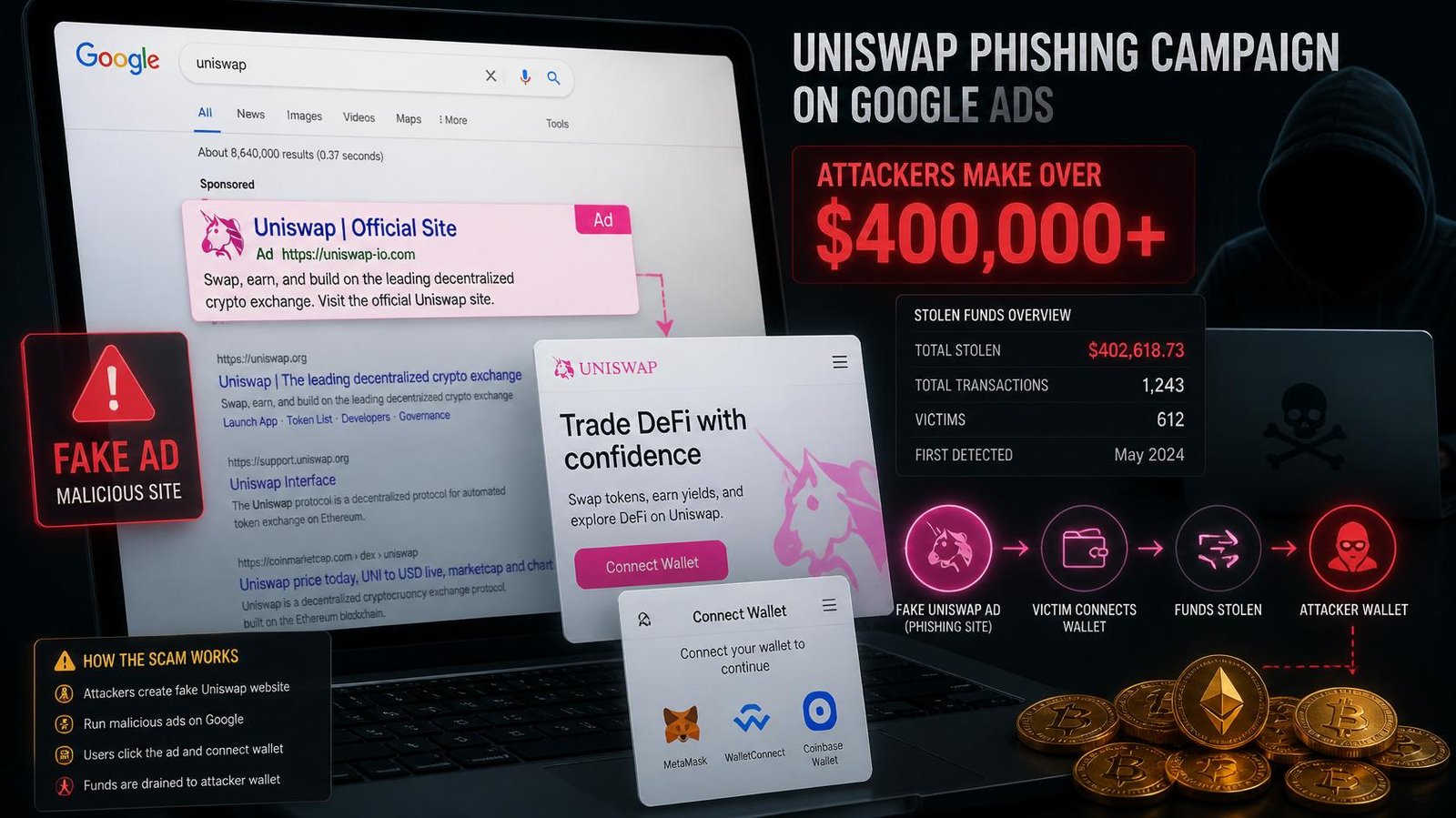
Crypto users are continuing to lose large amounts of money to phishing scams promoted through Google Ads, with attackers now using fake versions of Uniswap websites to steal funds from wallet holders.
According to on-chain analyst b-block, a phishing website impersonating Uniswap has already drained at least $400,000 from multiple victims.
The analyst shared wallet addresses linked to the operation that reportedly held around 146 ETH worth more than $300,000 at the time of reporting.
Stacy Muur said the scammers used sponsored Google search advertisements to place fake Uniswap links above the legitimate website in search results.
Victims who clicked the ads were directed to cloned websites that looked almost identical to the real Uniswap platform.
Once users connected their crypto wallets and approved transactions, attackers gained access to their funds without needing private keys.
Security experts say this method has become increasingly common across the crypto industry.
Blockchain security groups including Security Alliance and Scam Sniffer have repeatedly warned that phishing attacks using fake Google advertisements are increasing rapidly.
SEAL reported that phishing campaigns linked to malicious Google Ads stole more than $1.27 million within just a few weeks earlier this year.
The organization said scammers often either buy Google advertisements directly or hijack existing advertiser accounts to spread fake crypto links.
According to SEAL, attackers frequently outbid legitimate crypto companies so their phishing websites appear at the top of Google search results.
Security researchers also warned that scammers now use advanced techniques such as cloned interfaces, fake domains, hidden redirects, and invisible malicious code that can bypass automated detection systems.
DeFiLlama said fake Google ads remain one of the biggest entry points for crypto phishing attacks.
Meanwhile, PeckShield recently warned about similar phishing campaigns involving fake Aave advertisements appearing in Google searches.
Security experts are urging crypto users to avoid clicking sponsored links for exchanges or DeFi platforms and instead manually type official website addresses or use saved bookmarks when accessing crypto services.