Tishwash: Late-night meeting of the four presidencies to discuss three “serious” issues in Iraq
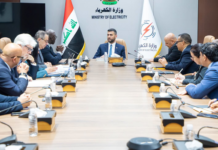
The four presidencies will hold an important meeting this evening, Monday, focusing on the issue of limiting weapons and options for confronting factions that refuse to disarm after the September 30 deadline.
According to an informed source who spoke to Shafaq News Agency, the meeting to be held between Prime Minister Ali al-Zubaidi, Speaker of Parliament Hebat al-Halbousi, President Nizar Amidi, and Head of the Supreme Judicial Council Faiq Zaidan will focus on two issues: first, restricting weapons, and second, continuing the fight against corruption and ensuring there are no red lines in pursuing any person accused of corruption, regardless of their governmental or political position.
The source explained that the meeting will also discuss the economic situation and the serious financial crisis that Iraq is going through due to the halt in its oil exports through the Strait of Hormuz, and possible solutions to confront the crisis in the coming period.
The issue of armed factions is one of the most sensitive issues facing the Iraqi government, with the approach of September 30, which the main political forces have set as the deadline for restricting weapons to official institutions.
In September 2024, Iraq and the United States agreed to end the military mission of the US-led international coalition against ISIS in Iraq, as part of a phased plan to move the security relationship between the two countries from the framework of the coalition to a bilateral partnership.
On Sunday, the State of Law coalition, led by Nouri al-Maliki, submitted a proposal to separate the date of the withdrawal of US forces from Iraq from the issue of disarming the factions, within the framework of a vision that is still “under study”.
Regarding the fight against corruption, a campaign of arrests was launched in Iraq in late June, targeting political officials, members of parliament, and businessmen, as part of a campaign called “Operation Dawn,” which Prime Minister Ali al-Zubaidi described as the “first phase” of broader measures to recover public funds, while tasking oversight bodies with receiving any indications related to cases of corruption or negligence in state institutions.
On the financial level, Iraq is experiencing a serious financial crisis, which has resulted in the delay in paying the salaries of a number of Iraqi state employees for the month of July, amidst accumulated living expenses and increasing economic pressures that have begun to be clearly reflected in the Iraqi markets. link
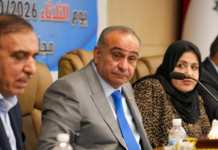
Tishwash: Minister of Communications: The decision to remove zeros and change the Iraqi currency has been finalized.
Communications Minister Mustafa Sand said that the decision to remove zeros from the Iraqi currency and change it has been finalized, noting that implementing this step will contribute to bringing hoarded funds out of the banking system and returning them to the economic cycle .
During a televised interview followed by Al-Sa’a Network, Sand added that “the currency exchange process will push those who hoard money to disclose it, while other amounts will remain outside the exchange process, especially money that its owners cannot show,” referring to money obtained from corruption or illegal activities, in addition to money that is lost or belongs to deceased people, which may reduce the size of the circulating cash mass.
He pointed out that “the value of the money that may not be exchanged could reach, according to his estimates, about 8 trillion dinars,” considering that “its non-return practically means that the state will not be obliged to issue its equivalent in new currency.”
Sand’s statements come after a wide controversy she stirred up regarding changing the Iraqi currency and removing zeros, as the “Eco Iraq” observatory denounced the announcement of sensitive economic and monetary decisions through unqualified entities, while the Central Bank of Iraq and the Ministry of Finance remained silent .
The observatory said in a statement received by Al-Sa’a Network that managing a file as large as the national currency through scattered statements, instead of official statements issued by the competent monetary and financial authorities, reflects a weakness in government coordination, warning that ambiguity may open the door to rumors and speculation and affect citizens’ confidence in the national currency, and demanding that the Central Bank and the Ministry of Finance issue an official clarification regarding the truth of the decision, its implementation mechanisms and its timetable . link
**************
Tishwash: Economic Observatory: Government silence regarding “currency change” is confusing the Iraqi dinar market
Observatory of Iraq criticized the confusion in the government’s discourse, which is represented in announcing sensitive economic and monetary decisions, such as changing the currency, through unqualified entities, amid the silence of the Central Bank of Iraq and the Ministry of Finance.
The observatory stated in a statement received by Shafaq News Agency that “managing a file as large as the national currency through scattered statements, instead of clear official conferences and statements issued by the competent monetary and financial authorities, reflects a weakness in government coordination,” explaining that “such confusion opens the door to rumors, speculation, market disruption, and harm to citizens and the country.”
The observatory warned that “this ambiguity affects the economic security of citizens and may affect their confidence in the national currency and increase the demand for foreign currencies and gold, thus exacerbating the state of anxiety in the market.”
Eco Iraq held the Central Bank and the Ministry of Finance “responsible for clarifying the truth about the decision and any confusion in the Iraqi market resulting from their silence,” demanding that the competent authorities “issue an official statement explaining the reasons for changing the currency, the implementation mechanisms, the timetable, and guarantees to protect citizens’ savings and market stability.” link
Tishwash: Iraq Struggles to Contain Volatile Dinar Currency Disparity
At a Glance
The Iraqi dinar reached its peak value during the 1970s when one dinar was worth four U.S. dollars.
Conflict and economic embargoes during the 1990s caused the currency to crash to 3,000 dinars per dollar.
The Central Bank fixed the official rate at 1,320 IQD, but parallel market rates remain high at 1,530 IQD.
The government has failed to contain the significant price gap between official state channels and open market vendors.
Channel8 has learned that decades of geopolitical conflict, sanctions, and market resistance have left Iraq unable to bridge the gap between its official 1,320 IQD peg and parallel market rates exceeding 1,530 IQD, cementing a historic decline from its four-dollar peak in the 1970s.
Key Statements and Focus Area
On current market disparity: A persistent, wide gap remains between Iraq’s official and market exchange rates, with open markets trading at 1,530 IQD despite the Central Bank’s 1,320 IQD official peg.
On structural historical declines: This modern monetary disparity mirrors the volatile historical trajectory of the Iraqi dinar, which collapsed from its historic peak of four dollars per dinar to some of its lowest historical levels.
On modern monetary interventions: Although the government devalued the dinar to 1,460 IQD in 2021 due to crashing oil revenues and later revalued it to 1,320 IQD in 2023, the market resisted, with street prices occasionally spiking to 1,700 IQD.
Chronological Eras of the Iraqi Dinar Value
1968–1979 (The Peak): The currency maintained its absolute highest valuation, trading at a stable rate of 1 IQD to $4.00 USD.
1980–1988 (The Iran-Iraq War): Wartime economic strain caused a minor depreciation, adjusting the value to 1 IQD to $3.30 USD.
1991–2003 (The Sanctions Era): Under a crushing economic blockade and excessive domestic printing, the currency collapsed to 3,000 IQD to $1 USD.
2004–2021 (Post-War Stabilization): The introduction of a new currency stabilized the market, keeping exchange rates steady between 1,180 IQD and 1,200 IQD per dollar.
In recent weeks, the Iraqi dinar strengthened against the U.S. dollar, with the exchange rate dropping from a peak of nearly 160,000 IQD to 153,000 IQD per 100 dollars.
This decline was driven by the U.S. government lifting restrictions on several private Iraqi banks and the Central Bank of Iraq addressing rumors of currency devaluation.
Market traders told Channel8 that ongoing government financial stabilization measures, including organized customs duty collections via the ASYCUDA system, helped restore public sector confidence, keeping the dollar from climbing back to its June peaks.
Speaking to Channel8 today, Jabar Goran, spokesperson for the Slemani Currency Exchange Market, highlighted that deleting zeros from the dinar would compel holders of hidden cash reserves to disclose their origins, effectively rendering tens of trillions in illicit funds unusable.
Goran also dismissed rumors of an Iraqi dinar exchange-rate adjustment, stating that a devaluation is unnecessary because rising revenues have offset increased expenditures.
The spokesperson previously predicted that if regional geopolitical tensions ease and vital maritime trade channels like the Strait of Hormuz remain stable, the parallel market exchange rate could significantly strengthen, potentially dropping down to a range between 146,000 and 147,000 IQD per $100 USD.
FYI
The Iraqi dinar was originally introduced into circulation in 1932. Following the regime change in 2003, the Coalition Provisional Authority introduced an entirely overhauled banknote series widely known as the “Bremer Print.”
This new issue systematically replaced both the pre-1991 high-quality “Swiss Print” and the poorly printed, easily counterfeited banknotes produced locally during the 1990s sanctions era.
This monetary timeline demonstrates that prolonged foreign wars, domestic mismanagement, and geopolitical shifts remain the primary drivers behind the dynamic instability of the dinar against global currencies. link
Tishwash: The Prime Minister’s advisor: The government has translated its promises into restructuring the national economy.
The financial advisor to the Prime Minister, Mazhar Muhammad Salih, affirmed on Saturday that evaluating Prime Minister Ali al-Zaidi’s government after 100 days in office should not be limited to the number of days it has spent in power, but rather to the direction it has chosen since taking office. He pointed out that the government assumed responsibility in a highly complex Iraqi context.
According to the official newspaper, Salih stated, “The government came to power in a highly complex Iraqi context: an economy heavily dependent on oil, a state burdened by a long administrative and financial legacy, entrenched corruption, security and sovereignty challenges, and increasing social pressure seeking job opportunities, services, and a decent life.”
He added, “Al-Zaidi’s government did not deal with these issues as separate crises, but rather tried to view them as parts of a single problem: building the state and restoring its ability to manage its resources and interests.”
He indicated that “the fight against corruption was at the forefront of the files to which the government gave clear priority,” explaining that “the importance lies not only in opening files or taking measures, but in moving the fight against corruption from the usual political rhetoric to a more institutional path based on oversight, recovering public funds, and holding those involved accountable.”
He explained that “transforming the fight against corruption into a declared and ongoing battle is an important step in the right direction, after corruption has become, for many years, one of the biggest obstacles to state-building.”
Saleh pointed out that “the al-Zaidi government did not merely manage the existing economy, but also proposed the idea of reforming its structure,” indicating that “talk of program-based budgeting, reforming the banking sector, developing the tax and customs systems, supporting the private sector, and creating new tools to finance development and investment reflects an attempt to move from an economy that relies on rent-seeking to one that can generate value.”
He emphasized that “Iraq does not lack resources, but rather the ability to transform those resources into production, job opportunities, and sustainable wealth,” noting “the importance of the government’s focus on investment, energy, and infrastructure, and its efforts to open the door to broader investment partnerships.”
He added that “economic diversification is not just a financial slogan, but the path to building a genuine labor market and reshaping the Iraqi middle class based on work, production, and efficiency.”
Regarding the private sector, Saleh explained that “Iraq cannot build its future relying solely on government jobs,” clarifying that “what is needed is an economy that creates opportunities outside the state and gives doctors, engineers, merchants, farmers, industrialists, and entrepreneurs real space to grow.”
He pointed out that “the government’s success in this direction will not be measured only by the volume of investments it attracts, but also by the number of productive jobs it creates and its ability to translate investment into tangible economic activity that citizens feel.”
At the level of the state and sovereignty, Saleh emphasized that “the insistence on the state’s monopoly on the use of force and the restoration of national decision-making sends a clear political message that building the economy cannot be separated from building the state,” stressing that “there is no strong economy without a strong state, no stable investment without a clear security and sovereign environment, and no stable middle class without institutions operating within the framework of the law.”
Regarding the energy sector, he noted that “the government views electricity and energy as more than just service-related matters; they are the foundation of industry, investment, and production, and any real success in this sector can have a positive impact on the entire economy.”
He explained that “the government’s actions in energy and investment can be interpreted as part of a broader project aimed at transforming Iraq from an economy that consumes its resources to one that can invest them.”
Saleh stated that “what is most striking about al-Zidi’s experience during this short period is that the government did not hide behind difficult circumstances, but rather tackled the most challenging issues, including corruption, oil revenues, public finances, energy, investment, the private sector, and sovereignty.”
He emphasized that “governments are not only judged by the files they close, but also by what they dare to open,” pointing out that “the first few months cannot be sufficient to judge the results of reforms that, by their nature, require years, but they can be enough to discern the government’s direction and political will.”
He clarified that “al-Zidi, in his economic discourse, does not simply propose increasing spending, but rather speaks of reforming the structure of the economy, and he does not address combating corruption as a media campaign, but as a national issue.”
He added, “The government does not treat the private sector as a mere guest in the Iraqi economy, but rather as a fundamental partner in wealth creation. It does not view energy as simply a service, but as a foundation for development. Nor does it separate sovereignty and stability from the ability to attract investment and build the economy.”
He emphasized that “the government’s success in translating its initial proposals into sustainable policies and tangible results means it will not have merely achieved scattered governmental accomplishments, but will have begun to redefine the relationship between the state, the economy, and the citizen.”
He pointed out that “the most significant value at the beginning of al-Zaidi’s term is the renewed focus on how to transition from a rentier state to a wealth-creating state, and from an economy where the rich get richer as opportunities dwindle for others, to an economy where increased individual wealth contributes to the wealth of society.”
Saleh concluded by saying, “The importance of the first hundred days does not lie in achieving everything, but rather in demonstrating that there is a government willing to address long-postponed issues.” He explained that “the courage to tackle these difficult files may be the first real achievement, even before its results become apparent on the ground.” link