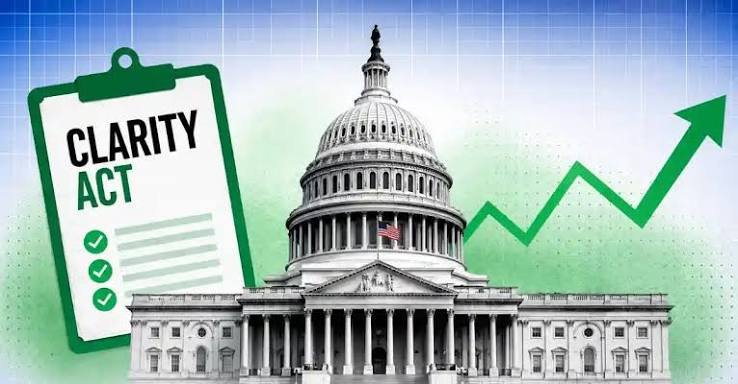
Coinbase CEO Brian Armstrong said the U.S. crypto industry could get clearer federal rules even if the CLARITY Act fails to pass its key Senate test on Sept. 15.
Armstrong said that if Congress does not move the bill forward, the Securities and Exchange Commission and Commodity Futures Trading Commission are ready to create their own crypto rules. He believes the industry could get more regulatory clarity either through new legislation or through federal agencies.
“If it passes, great, we’ve got legislation,” Armstrong said. He added that even if it fails, the SEC and CFTC have said they are ready to move ahead with rulemaking within days.
The CLARITY Act would create a federal framework for digital assets and divide regulatory responsibility between the SEC and CFTC. Digital assets treated as securities would remain under the SEC, while decentralized digital commodities such as Bitcoin would fall under the CFTC.
The proposed rules would also create requirements for crypto exchanges, brokers and other companies in the industry. Stablecoins and other digital asset issues remain important parts of the negotiations.
The Sept. 15 Senate action is a cloture vote, meaning the bill needs 60 senators to move forward. It is not the final vote on the legislation.
Armstrong said lawmakers have made progress through bipartisan negotiations and that many of Coinbase’s major concerns with earlier versions of the bill have now been addressed. He also said crypto companies, banks and law enforcement groups are supporting parts of the legislation.
However, the bill still faces political challenges. Republicans need support from Democrats or independents to reach the 60-vote requirement. Disagreements over stablecoin rewards and ethics rules for elected officials remain among the biggest issues.
Armstrong said the ethics provisions are still being negotiated but suggested that both sides are getting close to an agreement. He said the White House has proposed what he called a strong ethics provision, while Democrats have pushed for tougher rules, including possible requirements for officials to sell certain digital assets.
Armstrong also responded to criticism from parts of the banking industry over the stablecoin provisions. JPMorgan CEO Jamie Dimon has argued that Coinbase is seeking an advantage over traditional banks through the legislation.
Armstrong said some companies with large payments businesses have a competitive concern about the bill. He pointed to Goldman Sachs, BNY Mellon and Fidelity as financial institutions that support the legislation.
Beyond regulation, Armstrong said Coinbase sees payments made by AI software agents as a major future opportunity.
He described agentic finance as still being in its early stages but said the market could become very large. Coinbase is building this system around Base, USDC and its x402 payment protocol, which allows software agents to make payments online.
Armstrong said more than 90% of around 165 million agent payments so far have taken place on Base using x402 and USDC. He said Coinbase now has a leading position in this emerging market.
Coinbase has been expanding its tools for AI agents throughout 2026. The technology allows software agents to make payments, purchase services and manage wallets based on rules set by users or developers.
Armstrong also repeated his bullish long-term view on Bitcoin. He said his target of $400,000 per Bitcoin by 2030 remains a reasonable goal.
He also believes the current Bitcoin market cycle has already reached its bottom.
Armstrong previously said in August that Bitcoin could be entering its next major bull cycle. He continues to expect crypto adoption to grow significantly by 2030 as digital assets become more common in payments and financial services.
For now, the next major event is the Sept. 15 Senate vote. If the CLARITY Act passes the procedural hurdle, it can move toward further debate. If it fails, Armstrong expects the SEC and CFTC to begin their own crypto rulemaking shortly afterward.