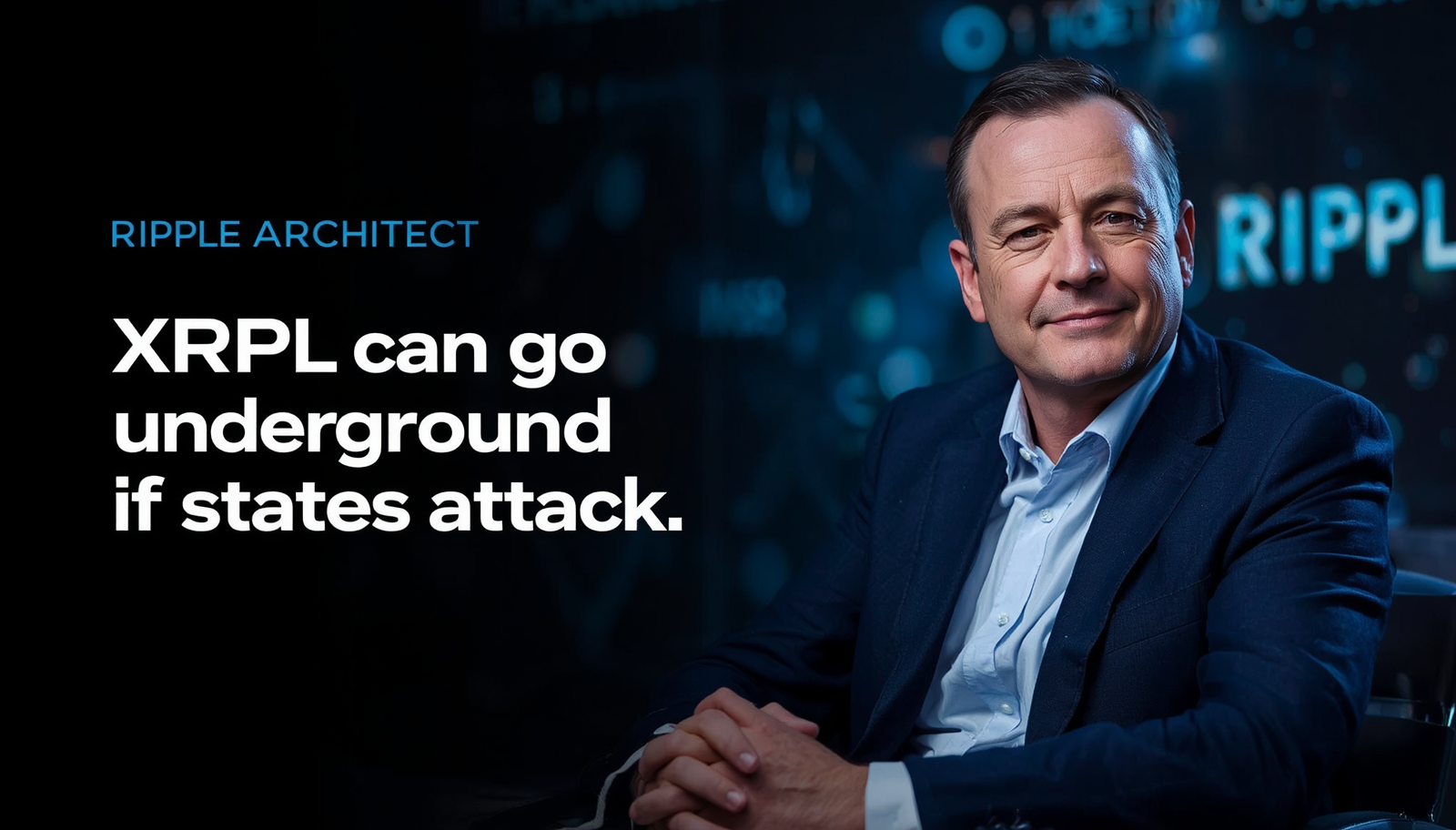
David Schwartz, the Chief Technology Officer Emeritus of Ripple, has shared how the XRP Ledger (XRPL) could continue operating if it ever faced extreme pressure from a government or state-level attack targeting validators, node operators, or critical network infrastructure.
The discussion began around a hypothetical scenario in which authorities attempt to shut down a blockchain network by raiding operators, disabling servers, or forcing validators offline. According to Schwartz, such actions could cause temporary disruption, but they would be unlikely to permanently stop the XRP Ledger.
He explained that XRPL’s software, validator network, and operating structure can adapt if users, developers, and network participants agree that changes are necessary to protect the network. This emergency response concept has been described as a “Doomsday” plan, designed only for extreme situations rather than normal day-to-day operations.
One of the key ideas involves using privacy-focused networks such as Tor and I2P. These technologies could help hide the identity and location of validators and network operators, making it more difficult for authorities to identify and target critical infrastructure.
Under such a system, primary transaction-processing nodes would continue operating while backup nodes could quickly replace any infrastructure that was disabled or seized. An additional support layer could also help manage trusted validator lists through anonymous communication channels, reducing the risk of widespread disruption.
The overall goal would be to keep the network functioning even if some validators or operators were taken offline.
The discussion also highlights a unique aspect of XRPL’s design. Unlike proof-of-work or proof-of-stake blockchains that rely on mining power or token ownership, XRPL uses a Unique Node List (UNL) model. Each participant chooses a list of trusted validators that they believe will act honestly and not work together to manipulate the network.
This structure allows the network to remain operational even when some validators fail or become unavailable. Features such as the Negative UNL mechanism already help XRPL continue processing transactions when trusted validators go offline.
The debate comes as the XRP Ledger continues to evolve through ongoing upgrades and new features. Recent updates have included improvements for NFTs, Permissioned Domains, Vaults, and lending-related functionality.
Schwartz has also recently discussed the differences between XRP and Ripple’s RLUSD stablecoin. While RLUSD can be frozen or recovered by Ripple under certain legal circumstances, XRP itself does not depend on a central issuer that can directly freeze user balances.
His latest comments do not suggest that XRPL is currently facing any government attack. Instead, they provide insight into how one of the network’s key architects believes the blockchain could respond if it ever encountered an extreme threat.
The broader message is that public blockchain networks are not static systems. According to Schwartz, their ability to adapt through software updates, validator coordination, and community agreement may be one of their strongest defenses against attempts to shut them down.