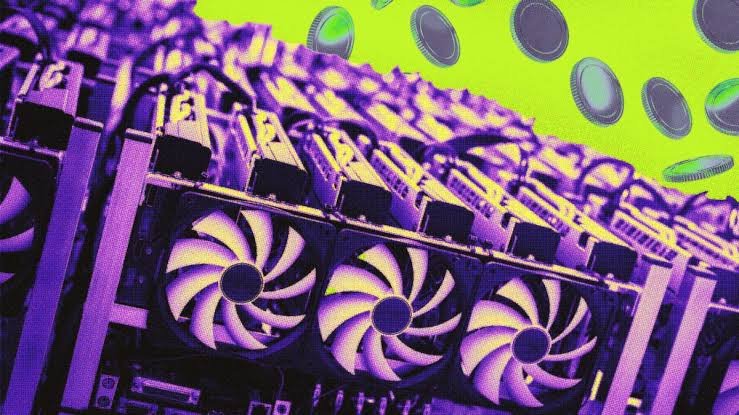
Bitcoin miners are going through one of the toughest periods the industry has seen in years. At the same time, many mining company stocks are rising, creating a surprising split between what is happening in Bitcoin mining and how investors are valuing these businesses.
According to Bitcoin Magazine Pro, Bitcoin mining difficulty has dropped nearly 20% from its peak, making this the third-largest mining downturn since ASIC machines became the standard mining hardware. Network data shows the same trend. Bitcoin difficulty fell again in July and is now roughly 19% below the all-time high reached in late 2025.
A major reason for the slowdown is Bitcoin’s price. On July 31, Bitcoin was trading around $63,100, nearly 50% below its October 2025 record. While miners still receive 3.125 BTC per block after the 2024 halving, the lower Bitcoin price means the value of those rewards has fallen significantly.
The pressure is showing across the network. Bitcoin’s hashrate, which measures the total computing power securing the blockchain, has fallen from its late-2025 peak. Different data providers use different measurements, but all of them point to the same reality: less mining power is active today than it was several months ago.
This decline is significant because it marks only the second time in Bitcoin’s history that mining difficulty has turned negative on a year-over-year basis. The first time happened after China banned Bitcoin mining in 2021.
Unlike the China crackdown, there is no single reason behind the current decline. Several factors are working together. Mining revenue has been squeezed by lower Bitcoin prices, older mining machines have become less profitable, and many companies are shifting power and infrastructure toward artificial intelligence and high-performance computing projects.
Mining profitability has become a challenge for many operators. Hashprice, a key measure of mining revenue, was sitting around $32 per petahash per day in late July. Older mining equipment often struggles to stay profitable at those levels unless electricity costs are extremely low.
The financial pressure has already forced many public mining companies to sell large amounts of Bitcoin. During the first quarter of 2026, listed miners sold more than 32,000 BTC. That was more than they sold during all of 2025 combined. Companies needed cash for operating expenses, debt payments, and the construction of new data-center projects.
While Bitcoin mining is struggling, investors are increasingly looking at miners as AI infrastructure companies rather than pure Bitcoin plays.
For years, mining stocks generally moved in the same direction as Bitcoin. When Bitcoin rose, miners benefited. When Bitcoin fell, miner stocks often fell even harder.
That relationship is changing.
Many mining companies now own valuable power infrastructure, land, and data centers that can be used for AI workloads. Investors see these assets as potentially more profitable than Bitcoin mining itself.
Hut 8 is one of the strongest examples of this shift. In July, the company signed another long-term AI data-center lease at its Beacon Point campus in Texas. The deal pushed its total contracted AI portfolio to $26.6 billion. Investors responded positively, helping the stock continue a strong rally over the past year.
Core Scientific is following a similar path. The company recently announced a major partnership with AMD supported by long-term agreements that could generate more than $14 billion in contracted revenue. Its leased customer capacity has now reached about 1.1 gigawatts.
TeraWulf has also seen AI-related revenue become more important than Bitcoin mining revenue. During the first quarter, revenue from AI and high-performance computing leases exceeded the income generated from mining Bitcoin.
These developments explain why mining stocks can rise even while mining conditions get worse. Companies are finding ways to generate revenue from AI infrastructure, and investors are betting that these businesses could become major players in the growing AI economy.
However, there are still risks. Many of these projects require years of construction, financing, and customer deployment. The announced contract values are not the same as money already earned. Delays, rising costs, or weaker AI demand could impact future results.
Another challenge facing miners is the lack of transaction fee revenue.
Bitcoin miners earn money from two sources: block rewards and transaction fees. The block reward currently stands at 3.125 BTC per block after the 2024 halving. That reward will be cut again during the next halving, expected in 2028.
Transaction fees remain very small compared to block rewards. During one recent seven-day period, miners collected only about 20 BTC in fees, averaging less than 3 BTC per day. Meanwhile, the network creates roughly 450 BTC in daily block rewards when blocks are produced normally.
This means fees are still covering only a tiny portion of miner revenue. While fees can rise during periods of heavy network activity, they remain far from replacing the block subsidy that miners currently rely on.
The long-term question is how Bitcoin’s security budget will evolve as future halvings continue reducing block rewards. Possible solutions include higher Bitcoin prices, greater fee demand, better mining efficiency, or a smaller but sustainable mining industry.
Despite the current difficulties, Bitcoin’s security is not under immediate threat. The network is still protected by hundreds of exahashes of computing power. Bitcoin’s built-in difficulty adjustment also helps stabilize the system. When miners leave, difficulty falls, making mining easier and more profitable for the operators that remain.
This process has always helped Bitcoin recover from mining downturns.
Still, the current cycle looks different from previous ones. Some mining sites are not simply shutting down and waiting for better conditions. Instead, they are being converted into long-term AI facilities that could remain focused on AI for the next 15 to 20 years.
Because of this, some analysts believe the industry is experiencing a structural change rather than a normal mining cycle.
The next Bitcoin difficulty adjustment in August will provide another important signal. If difficulty falls again, it could mean more miners are leaving the network. If it stabilizes or rises, it may suggest that the worst of the contraction is beginning to pass.
For now, Bitcoin mining remains under pressure, but the companies behind it are increasingly finding new opportunities in the rapidly growing AI sector. That shift is reshaping the industry and changing how investors view mining businesses.