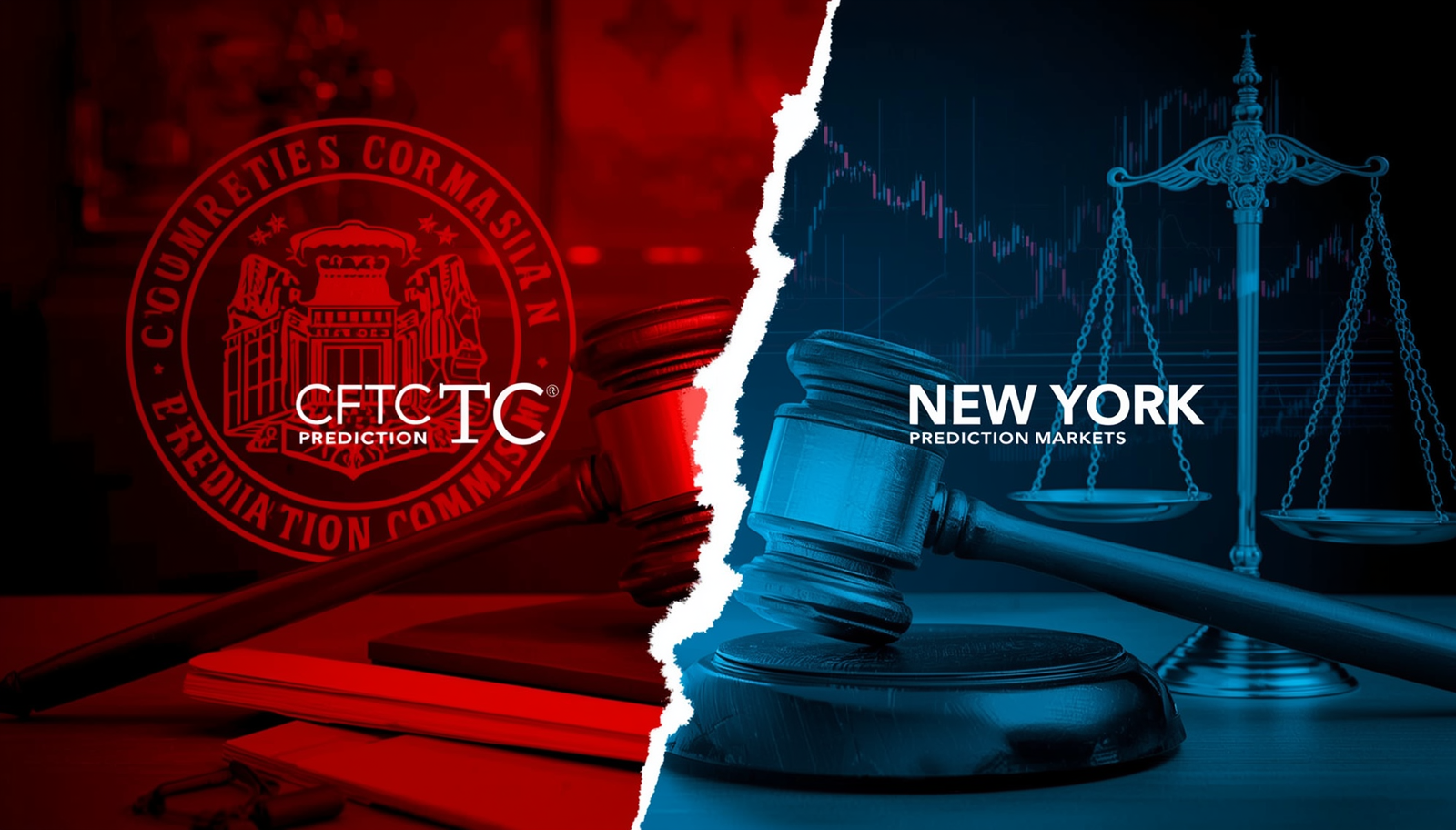
The fight over prediction markets in the US is getting much bigger, and now the CFTC is taking New York to court over it.
Summary
The CFTC has sued New York, saying the state is interfering with federal authority over prediction markets.
The case centers on whether event contracts are federally regulated financial products or state-regulated gambling.
The lawsuit adds to a growing national fight over who controls this fast-growing market.
At the center of this is one big question.
Are prediction markets trading platforms or gambling platforms?
That is what this fight is really about.
CFTC Says Federal Law Comes First
The CFTC argues prediction markets listed on federally registered exchanges fall under its authority, not state gambling law.
The agency says New York is crossing into federal territory by trying to police those contracts under gambling rules.
CFTC Chair Michael Selig said state lawsuits are threatening access to event contracts and challenging the agency’s sole jurisdiction over these markets.
That is why the regulator is asking a federal court to block New York from enforcing those laws against registered exchanges.
States Are Pushing Back
New York is not backing down.
The state has already gone after Coinbase, Gemini, and Kalshi, arguing some prediction products look more like betting than regulated market contracts.
And New York is not alone.
A coalition of 37 states and Washington, D.C. has backed tougher limits, arguing federal commodity law does not wipe out state sports betting oversight.
Their message is simple.
If it looks like gambling, states should still have a say.
Why This Matters
This is becoming a power struggle between federal regulators and states.
Prediction platforms say they offer legitimate financial contracts tied to events.
States say many of those products walk and talk like sports betting.
That difference matters because whoever wins this fight could shape the rules for the entire industry.
Not just for crypto-linked prediction markets, but for event contracts more broadly.
Pressure Is Growing
Several states including Arizona, Connecticut, Illinois, Massachusetts, Nevada, and New York have all moved against prediction platforms through lawsuits, orders, and enforcement actions.
Nevada recently extended restrictions on some Kalshi contracts, adding more pressure.
So this is no longer a niche legal dispute.
It is becoming a national regulatory battle.
Big Picture
The bigger issue is not just prediction markets.
It is jurisdiction.
Who controls this new category of markets — Washington or the states?
That answer could shape how event trading develops in America for years.
And right now, that fight is only heating up.