Government advisor: The Ministry of Finance is preparing a three-year emergency plan to boost revenues.
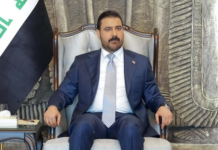
Money and Business Economy News – Baghdad The Prime Minister’s financial advisor, Mazhar Muhammad Salih, revealed on Friday five options to address the shortfall in financial revenues and restructure the Iraqi economy, in light of the challenges resulting from the decline in oil exports and the closure of the Strait of Hormuz, while indicating that the Ministry of Finance is moving towards preparing a three-year emergency plan to boost revenues.
Saleh said that “Iraq is facing a financial gap estimated at about $9.5 billion per month as a result of the decline in oil exports,” noting that “the Ministry of Finance is moving towards preparing a three-pronged emergency plan that includes internal and external borrowing, in addition to measures to maximize non-oil revenues through taxes, fees and financial reforms.”
He explained that “domestic borrowing is a quick solution to cover salaries and operational obligations, but it may lead to a withdrawal of liquidity from banks, an increase in the cost of local financing, and a weakening of private sector financing, while external borrowing provides liquidity in dollars and maintains relative monetary stability, but it is linked to reform conditions and an increase in debt service burdens.”
He added that “maximizing non-oil revenues is the most strategic option in the medium and long term, through controlling border crossings and customs, automating the tax system, reducing the informal economy, and improving collection without harming economic activity,” noting that “implementing the Government Financial Management Information System (IFMIS) contributes to strengthening financial oversight, reducing waste and corruption, and raising the efficiency of public spending management.”
Saleh stressed that “reforming the banking sector, especially Rafidain and Rasheed banks, is necessary to develop development finance, digital and credit services, as well as the importance of reforming private banks to achieve financial inclusion, support small and medium enterprises and attract investments.”
He explained that “activating the Public-Private Partnership Law would alleviate pressure on the general budget and create new job opportunities, provided that a stable legal environment, investment guarantees, and combating administrative corruption are provided,” stressing that “any emergency plan will not succeed without real financial reform that includes controlling operational spending, reducing waste in government contracts, and adopting spending priorities linked to production and development.”
Saleh explained that “the current crisis represents a real test for the structure of the Iraqi economy, which is dependent on oil,” stressing that “accelerating financial and banking reforms and diversifying the economy will enhance the state’s ability to cope with geopolitical and economic shocks.” https://www.economy-news.net/content.php?id=69391
Two Chinese Sources Reveal Efforts Beijing Might Make To Resolve The Strait Of Hormuz Crisis Between The US And Iran.
Arabic and international Economy News – Follow-up China may seek to intensify its diplomatic efforts with both the United States and Iran regarding the reopening of the Strait of Hormuz following U.S. President Donald Trump’s visit to Beijing last week, but it is unlikely to play a mediating role in the Iranian crisis, according to two sources familiar with the Chinese government’s thinking who spoke to CNN.
Wu Xinbo, an advisor to the Chinese Foreign Ministry, told CNN that China is eager to find a solution to the historic oil crisis triggered by the closure of the Strait of Hormuz, which has now entered its fourth month.
Wu stated, “We will work with both sides on this matter,” and continued, “We will maintain communication with the United States on this issue through diplomatic channels, because from the perspective of our national interest, reopening the Strait of Hormuz as soon as possible is a very urgent matter.”
US officials have publicly called on China to do more to pressure Iran to end the conflict on terms favorable to Washington. Trump has stated that he does not need the help of Chinese President Xi Jinping, even though the two discussed the need to reopen the Strait of Hormuz during their summit in Beijing.
But a Chinese source familiar with the situation said there are limits to how far Beijing will go to put pressure on Tehran.
The source, who asked not to be identified in order to speak freely, said: “China does want to push for an end to the crisis, but it will not use its economic leverage to pressure Iran, as the United States hopes.”
The source added: “China’s position is that it will not exert pressure on Iran in this regard, because the roots of the problem lie between the United States and Israel, and they should have a leading role in ending the crisis because they are the ones who started it.”
Countries like Pakistan have played a direct mediating role in talks between the United States and Iran. China, however, is less willing to assume this role, recognizing that whoever does so must maintain balanced relations with both the United States and Iran, a condition Beijing cannot meet, according to the source. https://www.economy-news.net/content.php?id=69393
US Secretary Of State: Some Progress Has Been Made In Negotiations With Iran
Arabic and international Economy News – Follow-up US Secretary of State Marco Rubio announced on Friday some progress in the ongoing negotiations with Iran.
The minister said at a press conference that “there has been some progress in the negotiations with Iran.”
He noted that he “does not believe any country would accept paying fees for passage through the Strait of Hormuz,” stressing that “this type of measure is internationally unacceptable.”
He added: “Attempts to impose fees on traffic in the Strait of Hormuz constitute extortion that no country will accept.”
WSJ: US Investigation Into Iran’s Use Of Binance Platform To Circumvent Sanctions
Dialogues Economy News – Follow-up The Wall Street Journal revealed that billions of dollars flowed through the Binance cryptocurrency trading platform to networks that fund the Iranian regime, at a time when the US Department of Justice is investigating Iran’s use of the platform to circumvent sanctions.
According to the newspaper, one of the top financiers of the Iranian regime conducted transactions worth $850 million through the Binance platform.
She added that Iranian businessman Babak Zanjani is the person responsible for these transactions through the platform, noting that US investigations are focusing on the mechanisms of using cryptocurrencies to circumvent financial restrictions imposed on Tehran.
Read also
Last April, the US Treasury Department’s Office of Foreign Assets Control imposed sanctions on a number of electronic wallets linked to Iran, resulting in the freezing of $344 million in cryptocurrency, according to TASS.
US Treasury Secretary Scott Bessent announced that these measures are part of ongoing efforts to prevent Tehran from “providing, transferring, and bringing funds home,” stressing via the “X” platform that the department will continue, as part of the “economic wrath” campaign, to systematically deny Iran access to its financial resources.
Bisent added that the United States will track all funds that Tehran tries to take out of the country, and will target the various sources of funding associated with ithttps://www.economy-news.net/content.php?id=69390
European Stocks Rise Amid Signs Of Progress In US-Iran Talks
Stock Exchange Economy News – Follow-up European shares rose on Friday as investors were optimistic that there were signs of progress in US-Iranian peace talks, despite the two sides continuing to disagree on key issues.
The pan-European STOXX 600 index rose 0.5% to 623.79 points by 07:03 GMT, and is on track to end the week higher.
The main points of contention between Tehran and Washington are Iran’s uranium stockpile and control of the Strait of Hormuz, through which, before the war, more than 20% of the world’s energy needs passed, according to Reuters.
U.S. Secretary of State Marco Rubio said there were “some good signs” in the talks, and a senior Iranian source told Reuters that the gap between the two sides had narrowed.
Analysts expect that reaching an agreement that includes opening the strait will lead to a rise in European stocks, which have lagged behind their counterparts because the region’s reliance on oil imports has negatively affected markets and led to higher inflation.
Official data showed German consumer confidence recovering as June approached, and other data confirmed that the German economy grew by 0.3% in the first quarter of 2026. The DAX index rose 0.7%.
Financial markets expect the European Central Bank to raise interest rates at least twice before the end of the year.
Shares of Richemont, owner of the Cartier brand, rose 4.2% after it announced better-than-expected revenue in the fourth quarter. https://www.economy-news.net/content.php?id=69395