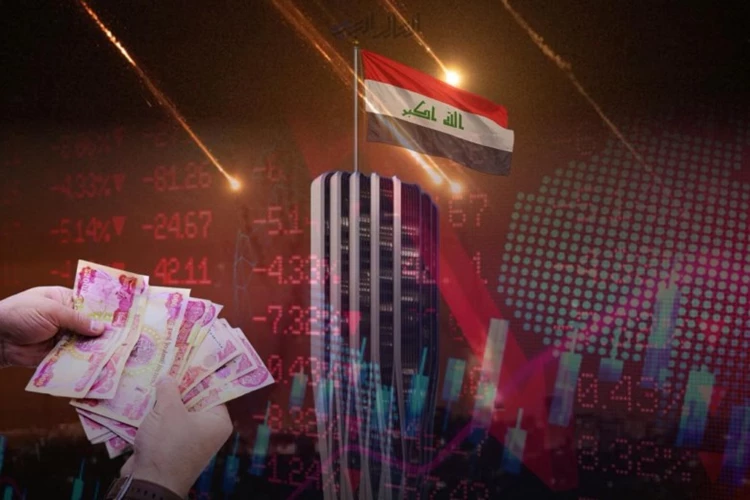
Iraqi officials and economic figures are increasingly debating how the government can continue financing salaries and essential spending amid growing regional tensions and pressure on oil revenues, with domestic borrowing emerging as the most immediate option.
Economic expert Safwan Qusay said the government remains legally obligated to guarantee salaries, social welfare payments, and food-ration programs, stressing that Baghdad still has tools available to finance the deficit.
According to Qusay, the closest short-term solution is domestic borrowing from Iraqi banks and financial transfers until oil exports stabilize and revenues return to normal levels. He said Iraq can secure salaries for approximately six months starting from May 1.
However, he warned that policymakers must also think beyond the immediate period and develop alternative export mechanisms capable of protecting oil revenues without draining the reserves of the Central Bank of Iraq or weakening the Iraqi dinar through inflationary pressures.
Qusay added that Iraq’s heavy dependence on oil exports leaves the country highly vulnerable to geopolitical escalation in the region, particularly amid growing confrontation between the United States and Iran and fears of wider disruptions affecting Gulf energy routes.
Former Iraqi MP Yasser al-Husseini criticized candidates for positions in the incoming government, saying many failed to present realistic economic plans for dealing with declining revenues and rising fiscal pressures.
He noted that Iraq’s three-year budget law contains a clause allowing the government to resort to internal borrowing to finance expenditures. At the same time, he warned that the government has already borrowed extensively from available financial funds, leaving many of those reserves depleted and limiting future liquidity options.
Meanwhile, Iraqi MP Shaker Mahmoud cautioned that continued reliance on internal borrowing without structural economic reform could place severe long-term pressure on the national budget.
Mahmoud said the government’s dependence on temporary solutions and “patchwork fixes” risks undermining the state’s future ability to finance essential obligations such as salaries and public service projects.
He called for an urgent emergency plan focused on controlling public spending, diversifying income sources, and reducing Iraq’s reliance on oil revenues, which he described as still dominating Iraqi financial decision-making.
The debate reflects mounting concern inside Iraq over the sustainability of public finances as oil-price volatility, regional instability, and rising expenditure commitments continue to strain the country’s economic outlook.