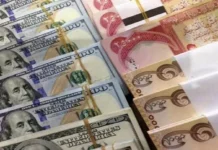
Tishwash: The Iraqi dinar is under pressure from the financial crisis and fears of declining monetary cover.
Warnings are increasing about the repercussions of the financial crisis on the stability of the Iraqi dinar, with growing talk about the possibility of using part of the cash reserve to cover government expenses.
Economic expert Dr. Safwan Qusay confirmed the possibility of resorting to the cash reserves of the Central Bank of Iraq, given the existence of an amount exceeding $90 billion, while warning at the same time of the occurrence of inflation within Iraq.
Qusay said that “the Central Bank of Iraq’s reserves amount to $90 billion in addition to 170 tons of gold, and if borrowing from these reserves is relied upon, it is possible to continue with financial flexibility up to $60 billion.”
He added that “the $60 billion represents the value of the issued Iraqi dinar, but the dinar’s value falling below the aforementioned financial cover means allowing inflation to occur domestically.”
He explained that “the possibility of resorting to borrowing from the central bank’s reserves, or the occurrence of the aforementioned inflation, may happen six months after this May, as the government can secure salaries for this period of time.” link
Tishwash: Zaidi formally assumes office, pledges economic reform and fight against corruption
Ali al-Zaidi officially assumed his duties Saturday as Iraq’s prime minister and commander-in-chief of the armed forces during a handover ceremony at the Government Palace in Baghdad attended by former Prime Minister Mohammed Shia al-Sudani.
In his first address to Iraqis after taking office, Zaidi outlined priorities including economic reform, anti-corruption measures and improvements to public services.
“I extend my sincere thanks and appreciation to the Council of Representatives for the national vote of confidence,” he said, also thanking Coordination Framework leaders and political parties involved in forming the government.
Zaidi said his administration would pursue “a comprehensive economic and financial reform program aimed at building a strong, diversified, and sustainable national economy that does not rely on a single resource,” focusing on industry, agriculture, tourism and investment. He pledged to combat corruption, describing it as “an obstacle to development and delays the progress of the state,” and said creating jobs for young people through development projects and private sector support would be among the government’s top priorities.
On services, Zaidi said “the file of services and infrastructure will no longer remain hostage to deferred promises,” committing his government to projects covering electricity, water, roads, sewage, transportation and housing. He also promised reforms in education and healthcare, including developing school curricula and improving hospitals across urban and rural areas.
Parliament approved 13 ministers Thursday during a session attended by 266 lawmakers. Several nominees failed to secure confidence, including those for planning, higher education, interior and construction and housing. Voting on defense, labor, migration and youth and sports ministries, along with deputy prime minister positions, was postponed. link
***************
Tishwash: President Al-Zaidi: Economic reform, fighting corruption, and providing job opportunities are at the top of the government’s priorities.
Prime Minister Ali Faleh al-Zaidi confirmed on Saturday that the next phase will witness the launch of a comprehensive economic and financial reform program, while stressing the need to protect public funds, fight corruption, and improve basic services in the country.
In a televised address to the Iraqi people on the occasion of his official assumption of duties as Prime Minister, Al-Zaydi said that he extends his sincere thanks and appreciation to the House of Representatives for granting him confidence, and he commended the role of the leaders of the Coordination Framework and the national political forces in the success of the government formation process.
He added that the next phase will be “a phase of genuine national partnership that transcends differences,” pledging to work to confront challenges with a spirit of responsibility and cooperation.
Al-Zaydi explained that his government will prioritize the implementation of an economic and financial reform program aimed at building a strong, diversified and sustainable national economy, based on revitalizing the industry, agriculture, tourism and investment sectors, in addition to supporting national energies and Iraqi competencies.
He indicated that the government will work “with all its might” to protect public funds and combat administrative and financial corruption in all its forms, considering it an obstacle to development and the progress of the state.
Regarding employment, the Prime Minister stressed that providing job opportunities for young people and reducing unemployment rates will be at the forefront of the government’s concerns, through launching productive and developmental projects, encouraging investment, and supporting the private sector.
He also stressed the importance of achieving social justice and ensuring the fair distribution of opportunities among citizens, away from favoritism and discrimination, in order to strengthen the principle of citizenship.
In the education and health sectors, Al-Zaydi announced plans to support education exceptionally by developing curricula and upgrading schools and universities, as well as improving medical and health services, developing hospitals and health centers, and providing treatment and medicine to all citizens.
He stressed that the services and infrastructure file will be “a field of work and achievement,” through the implementation of strategic projects to improve electricity, water, roads, sewage, transportation and housing.
He pointed out that his government would be “a government of institutions, law and justice,” working to consolidate security and stability, protect Iraq’s sovereignty and strengthen Arab, regional and international relations on the basis of mutual respect and common interests.
Al-Zaydi also expressed his gratitude to the supreme religious authority, praising its role in maintaining social peace, in addition to his appreciation for all religious and national institutions and symbols from the various components of the Iraqi people.
The Prime Minister concluded his speech by emphasizing that “the path of reform may be difficult, but it is not impossible when intentions are united and efforts are sincere,” stressing that Iraq deserves to rise up and achieve a dignified life for its people. link
Tishwash: A potential legal crisis: An expert comments on the government borrowing without an approved budget.
On Saturday (May 16, 2026), economist Nabil Al-Marsoumi sparked controversy regarding the government’s legal powers in the matter of borrowing in the absence of a federal budget.
Al-Marsoumi said, in a clarification on the Facebook platform followed by “Baghdad Today”, that “there is no text in the Financial Management Law No. 6 of 2019 that allows the government to borrow in the event that the federal budget law is not enacted, and Article 13 of the law only stipulates that: (In the event that the approval of the federal general budget is delayed until December 31 of the year preceding the year of preparing the budget, the Minister of Finance shall issue a circular according to the disbursement mechanism at a rate of (1/12) (one/twelve) or less of the total actual expenditures for current expenditures for the previous fiscal year, after excluding non-recurring expenditures, on a monthly basis until the federal general budget is approved).”
He added, “Looking back a little, we find that the collapse of oil prices during Al-Kadhimi’s time in 2020, and the inadequacy of public revenues to cover salaries, prompted Al-Kadhimi’s government to resort to Parliament to legislate a law that would allow it to borrow. The first was the Borrowing and Financial Deficit Treatment Law No. 5 of June 2020, in which the Minister of Finance was authorized to borrow locally and externally, not exceeding $5 billion for external borrowing, and 15 trillion dinars for internal borrowing.”
Al-Marsoumi continued, “The second borrowing law and the treatment of the financial deficit was issued on 11/12/2020, to secure the salaries of employees and retirees for the last months of 2020, with a value of 12.5 trillion dinars, after the state treasury reached a stage of being unable to pay salaries.”
He pointed out that “all the internal and external borrowing operations that the Sudanese government resorted to, which exceed 10 trillion dinars this year, lack the legal cover represented by the absence of a general budget in 2026, and the absence of any other law that allows it to borrow, and that any other borrowing operations that the Al-Zidi government will resort to, without the availability of legal cover, are also considered a legal violation and an overstepping of its powers specified in the Iraqi laws.” link